Sunday, December 4, 2011

OUTSTANDING U-S-T ALUMNI FETED IN ARLINGTON, VIRGINIA


A chemical engineer who helped write literature on the use of umbilical cord blood to harvest stem cells, a multi-awarded poet, and the only newspaperman to become a police general are among this year’s outstanding “Thomasians” recognized by the University of Santo Tomas Alumni Association in America (USTAAA).


The achievement awards were handed out Dec. 3 at the association’s 1st Anniversary and Quadricentennial Celebration Year-End Ball in Arlington, Virginia.

The UST, founded in 1611, is one of the oldest universities and predates Harvard, America’s oldest university by about 25 years. It is also one of the largest Catholic schools in terms of enrolment in a single campus.


Philippine national hero Jose Rizal is perhaps its most famous alumni, but they also include 4 Philippine presidents – Manuel L. Quezon, Sergio Osmena, Jose P. Laurel and Diosdado Macapagal – and 6 Chief Justices of the Philippine Supreme Court.

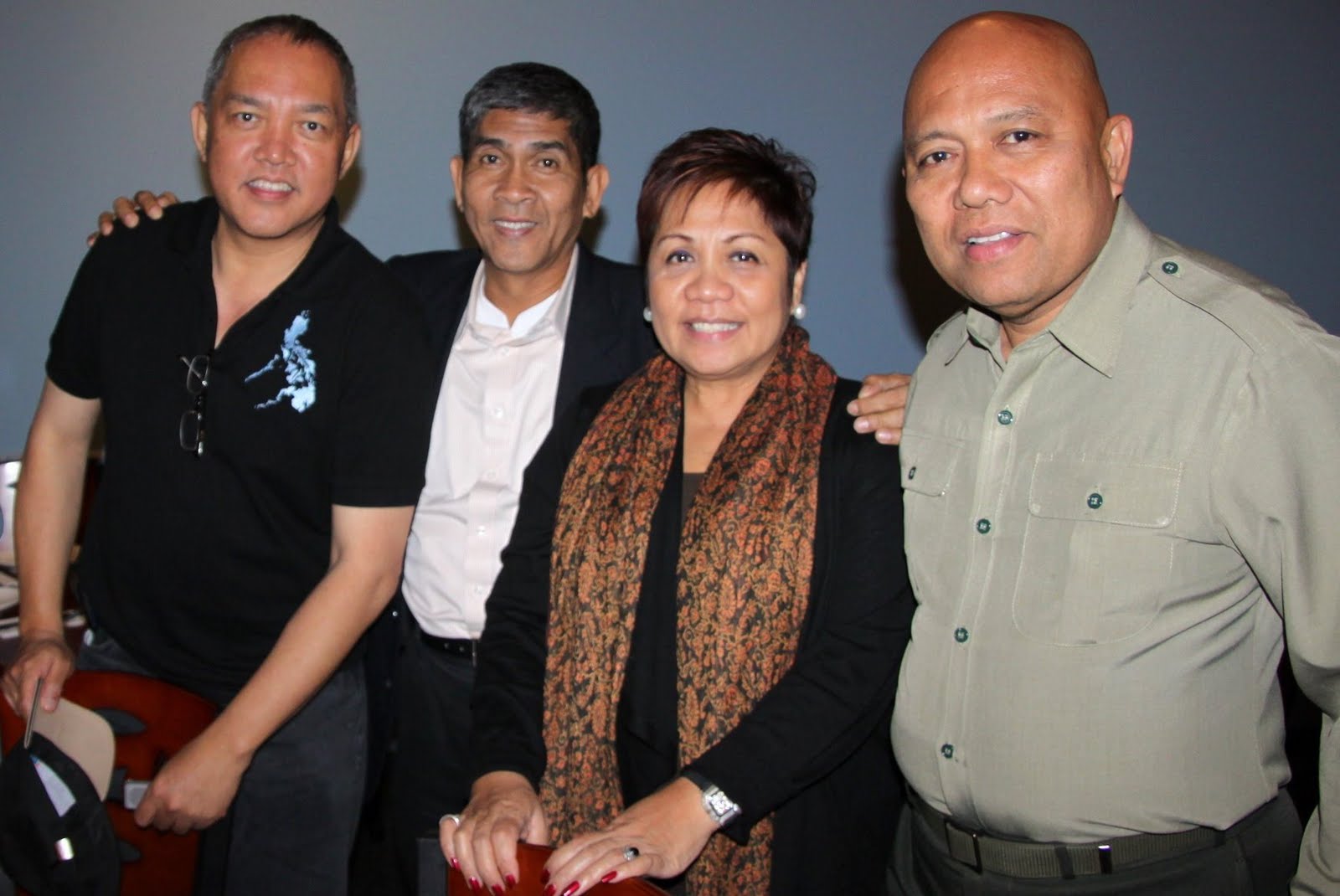
This year’s crop of achievers include retired police general Crescencio “Cris” Maralit (AB Journalism ’68), who has the distinction of being the 1st and only newspaperman to reach star-rank. He co-authored the book “Constabulary Story” and received 47 medals and awards, including 3 Bronze Cross Medals, 3 Distinguished Service Medals and 6 Military Merit Medals, among others.


Maralit also finished courses at the Command & General Staff College in the Philippines, psychological operations at Fort Bragg in North Carolina and senior crisis management in California, among others.

Now a Baltimore resident, he helped organize a benefit golf tournament last year to benefit victims of the Maguindanao Massacre and other murdered journalists.


Educator Vickie Salera Lopez (BS Electronics and Communications Engineering ’77) travelled over 25,000 miles to help beleaguered Filipino teachers in Maryland find new jobs in schools as far away as Arizona and New Mexico.


She is a certified Math teacher in Maryland and a member of the Maryland Educators for the Gifted and Talented. In the Philippines, Lopez designed the “Bayani sa Loob ng Tahanan” which combines adult and 1st grade education, helping parents to teach their children reading, writing and arithmetic.


She spent almost 2 decades setting up new departments, Total Quality programs and managing lay-offs for semiconductor and telecommunication companies in the Philippines. Lopez also taught at the UST College of Engineering and College of Architecture, and part-time in San Beda College Alabang.

Amy Pascual-Quinto (Fine Arts ’74) designed the UST commemorative tags for Maryland vehicles, the 1st time this privilege was bestowed to a Philippine university. She is a member of the Rockville Art League.
She had lived in Spain, France and Germany where she helped establish Tipanan, a weekend home for distressed Filipino domestic workers in Madrid that spared them the ordeal of having to sleep in the streets.


Dr. Wilhelmina Gardose Camina has previously been named one of the Twenty Outstanding Filipinos Abroad (2007) and received the Women of Achievement Award from the United Cultural Convention in 2010, among others.

Luz Bagtas Ricafort (BS Chemical Engineering ’63) is a multi-awarded medical technologist in the US and co-authored papers on the use of umbilical cord blood as a source of stem cells in patients afflicted with diabetes, Lou Gehrig’s disease, Parkinson;s and other neurological disorders. She was one of the first members of the International Society of Cord Blood Transplantation.


Ike Santos (AB English, Pre-Law ’63) is one of the most active civic leaders in the Metro Baltimore area (he is president and chairman of the Taytay Association of America, Inc.). He had founded or managed various non-profits that help raise funds for community and livelihood projects in the Philippines. He is currently involved with First Act Inc. that aims to harness and develop Filipino American artists through workshops and staging shows for the visual and performing arts.


Susana Bonifacio Felizardo (Literature and BS Education) is a multi-awarded poet and 2-time winner of the Una Chapman Cox Award (in 1990 and 2010), the highest award given for a Language and Culture Instructor.

She is a certified Tagalog tester and language examiner at the State Department’s National Foreign Affairs Training Center – the premier training ground for foreign service officers being posted overseas. Felizardo is also a Tagalog translator at the State Department’s Office of Language Service and interpreter/transcriber with DC, Maryland and Virginia courts.

Dr. Catherine Panlilio Arzadon (BS Medical Technology ’89 and Medicine ’93) started her practice as a pediatrician in her home town of San Fernando, Pampanga. Even while studying at UST, Arzadon was already an active volunteer and launched in 1999 Project MuntingNgiti that was transformed into a foundation 5 years later. She is assistant chief medical officer of Medical Mission of Mercy USA, a non-profit that provides free medical, dental and optometric services to indigents in the Philippines.


Belan Woo-Siy (College of Architecture & Fine Arts ’74) has successfully mounted several exhibits in Texas since 1988. She has won awards in art competitions for her paintings but has also worked with ceramics. She also contributed a short story to the book Transforming Non-Fiction to Fiction.

Greg Abella is this year’s USTAAA president. A retired US Navy Chief Petty Officer, he spent over 22 years in the uniform and is now Director of the Air Conditioning and Refrigeration School, facilitator of Total Quality Leadership and Management, and a Master Training Specialist.

Fernando Mendez (Fine Arts ’74) is an advertising man. He was art editor of The Varsitarian, the official publication of UST, and has won various awards for poster design, illustration, painting and photography; aside from 30 other excellence awards in advertising, logo design and art direction. He worked for some of the biggest ad agencies in Manila, including as Art Director handling multinational accounts like Scott Tissues, San Miguel and Marlboro.

He immigrated to the US in 1982, continued to work for different companies and established a decade later Special Edition Press Inc. in New York City. In 1997 he launched Philippine Fiesta USA Inc. that holds one of the biggest Filipino cultural festival and trade exhibit in the East Coast.

Claudio Pedery (Liberal Arts) is a logistics engineer, system analyst and decorated US Navy officer. He serves as or has worked as human relations commissioner in Prince George’s County, Maryland; President of Grace Dagdag Foundation; member of the Philippine Centennial Commission coordinating committee in Washington DC; President of the National Asian Pacific American Heritage Council; Department Commander of Veterans of Foreign Wars District of Columbia and Commander of VFW Post 5471, among many others.


Manny Tan (BS Commerce ’66) was cited for his role in the Growling Tigers, the UST basketball team, that made it to the University Athletic Association of the Philippines (UAAP) championship in 1963, and under coach Caloy Loyzaga, a back to back reprise in 1964 and 1965. He migrated to the US and 1982 and set up the Balikbayan Travel & Tours Inc.

Parents recognition awards were given to Rechilda Lumauig-Uy (Education ’64) whose husband, a doctor, and two children are all Thomasians, and Elisa Quintana, who ran a canteen near the Administration building and sent all 6 of his children to UST.

Special awards were also given to Eric David (Fine Arts ’74), CEO of Art Enrico Graphix; Bombie Reyes, an engineer with VR Group; and Manila Mail editor and ABS-CBN Washington DC correspondent Rodney Jaleco.

Monday, November 28, 2011

FIL-AMS QUARREL OVER FORMATION OF BASKETBALL "TEAM PHILIPPINES"

(This article appears in the Nov. 30, 2011 edition of Manila Mail, the longest running Fil-Am newspaper in the Metro DC region)

A full-blown melee has erupted between what is reputedly the biggest Filipino-American basketball league and members of a local hoops association that is hosting the championship in Washington DC next year.

The North American Basketball Association (NABA) has threatened to expel anyone playing for “Team Philippines” – a newly-formed group that aims to recruit young but talented Fil-Ams for international tournaments playing under the Philippine flag.

Russell Casapao, president of the DC-based Filipino Youth Basketball Association (FYBA), pitched for the establishment of “Team Philippines” reportedly without the knowledge of his board. But after the controversy broke-out, the FYBA members have come out to assail the threatened expulsions.

“The unity and harmonious relationship enjoyed by NABA members for the past 24 years has been challenged by the introduction of a new group, they call themselves Team Philippines,” Detroit-based NABA Commissioner Dr. Ron Damasco wrote in a letter to members posted in its website last month.

“The idea caused some confusion to some basketball players of NABA that started joining (Team Philippines). Their actions jeopardize the preparations of Washington DC franchise as host for the 2012 NABA tournament.

“I don’t have any other alternative but to enforce a directive to all NABA members that any city, team, player and coach that will join Team Philippines and any league other than NABA will be dealt accordingly with possible suspension or most likely expulsion,” Damasco warned.

In a letter by “The FYBA Organization” they announced that they will ask Dr. Damasco to reconsider his directive. “We are doing this to protect our players, coaches and more importantly the parents, to clear any misconception and confusion brought about by the establishment of Team Philippines and its impact to FYBA’s hosting of the 2012 NABA Inter-City tournament.”

The nucleus of “Team Philippines” reportedly come from the Metro DC region but also come from as far away as Florida.

The NABA has been holding yearly tournaments since 1986. The championships are held during the Labor Day weekend in either the US or Canada. With close to 2 dozen member cities from North America with 115 teams and over 1,700 athletes, the NABA tournament is perhaps the biggest Fil-Am sports event.

The FYBA is celebrating its 5th year (and NABA’s 25th anniversary) by hosting the Labor Day championship in Washington DC next year. That could be in jeopardy because many of the sponsors for next year’s tournament are parents of Fil-Am children in “Team Philippines”.

In a follow-up letter Nov. 18, Dr. Damasco said that “A member joining Team Philippines is not only committing conflict of interest but he is also at risk of developing a feeling of dejection, sadness and misery that could lead to his losing interest in basketball if in the end he is selected as member of Team Philippines.”

In a petition by about 40 parents of kids who’ve joined Team Philippines, they countered that “We believe that no child should be denied a chance to join any basketball organization and participate in their respective tournaments.”

“Parent should be able to freely exercise their right to choose whatever sports organization they believe will offer the best sports experience for their child. Whether it is Team Philippines, AAU or any school-sponsored sports program, the right to participate should be open to all who are qualified,” they stressed.

“Denying a child to play in an organization designed to promote pride in their heritage and to establish camaraderie among their fellow Filipino-American and Filipino-Canadian players across the nation and internationally is simply wrong and we will do everything within our power to correct this injustice,” the parents declared.

The Manila Mail learned that some are already contemplating a discrimination suit against NABA, threatening to blow the controversy even wider.

Meanwhile, they are also incensed that some ranking FYBA officers have refused or are unwilling to take the cudgels for their children. They are especially critical of Casapao whom Manila Mail sources say face his own “expulsion” by being pressured out of his presidency.

The group supporting Team Philippines has already met with NABA’s executive adviser Larry Albano in New York to apologize for the confusion arising from the group’s sudden appearance. “It is our hope that we can find and agree on a resolution that is fair to the players and their family who are currently supporting both organizations,” they reported.

But this attempt to mend fences apparently fell on deaf ears after Dr. Damasco issued his expulsion threat. “NABA is a self-governing, self-reliant and self-supporting association whose primary concern is the well being of every member,” he stressed.

Friday, November 25, 2011

VETERANS SEEK HELP FROM U-S ARMY FOR WARTIME RECORDS

Thousands of Filipino World War II veterans are hanging by a piece of paper that could spell the difference whether they receive compensation for a 6-decade-old injustice.

Eric Lachica, executive director of the American Coalition of Filipino Veterans (ACFV), said the problem of more than 4,000 veterans whose applications for the Filipino Veterans Equity Compensation (FVEC) fund were rejected is no longer within the purview of the Department of Veterans Administration (VA) to resolve.

In a chance meeting with US Defense Secretary Leon Panetta during a Veterans Day breakfast event at the White House, Lachica said they sought his help to help arrange a meeting with Secretary of the Army John McHugh.

He said Panetta was aware of the Filipino veterans “especially the Philippine Scouts, there’s so many of them in California” but did not know about the plight of those left out of FVEC benefits.


ACFV executive director Eric Lachica with Defense Secretary Leon Panetta at the recent Veterans Day breakfast at the White House. Photo courtesy of Eric Lachica.


“He said he’ll look into it,” Lachica told the Manila Mail.

In a letter addressed to President Obama, ACFV president Patrick Ganio Sr. pointed out “All are in their 80s and 90s and are in frail health. Many are United States citizens. Most reside in the Philippines and are cared for by family members. Sadly, many have died and their surviving spouses have tirelessly pursued their claims under the FVEC law.”

Lachica said he handed the letter to the President’s military aide.

McHugh has control over the US Army personnel records, including those presumably destroyed by a fire at their main repository in St. Louis, Missouri in 1973. The National Personnel Record Center (NPRC) contains service information for US military personnel who served after World War I.

The fire destroyed about 80 percent of the records for US Army personnel discharged between 1912 and 1960. According to its website, they have not yet determined “exactly what was lost in the fire because there were no indices to the blocks of records involved”.

An estimated quarter of a million Filipino soldiers and guerillas who served and fought under the US Armed Forces during World War II were disenfranchised by an act of Congress in 1946. They have been fighting for recognition ever since.

“We are pursuing the appeals,” Lachica said, “the Secretary of Veterans Affairs has told us the problem lies in the recognition of these veterans and that will depend on the US Army confirming that they actually served.

As of Oct. 1, the VA said 42,713 applications were processed. Of these 9,334 were approved for Filipino veterans in the Philippines and 9,165 for Filipino veterans in the US. A total of 24,214 applications were rejected.

Philippine-based veterans were entitled to a single lump sum payment of $9,000 while those in the US stood to receive $15,000. The VA reported that $221 million from the FVEC has been paid out already.

Some 4,389 of those rejected have filed notices of disagreement (NODs) but of this number, only 193 cases have been reopened. After lodging a NOD, a claimant will be provided a hearing either through video conference or face-to-face meeting.

Lachica revealed that retired Maj. Gen. Delfin Lorenzana, head of the Philippine veterans office at the Philippine Embassy in Washington DC, has been pressing the NPRC for whatever records they could find to help the veterans.

He cited the case of Virginia-based Celestino Almeda, 94, who had original copies of his discharge papers and payroll records from the US Commonwealth Philippine Army but was still turned down because his name did not appear in the so-called Missouri List.

Almeda used those same documents to acquire US citizenship in the 1990s.

Lachica there is still about $44 million in the FVEC fund that could be used to pay the veterans. “That’s why we have to make sure the appeal process is resolved for most of our veterans who believe they are legitimate US veterans,” Lachica declared.

“We want to meet with the Secretary of the Army or his staff to ask them to review individually, case-by-case the paperwork of these 4,000 because if the Secretary of the Army will release a paper certifying they served based on the records, they will get the equity compensation,” he explained.

In addition, they continue to lobby for passage of the family reunification bill to speed up immigrant petitions filed by veterans for their children to join them in the US, and “medical portability” that will allow aging veterans to “carry” their Medicare benefits back to the Philippines if they wished to spend their remaining years there.

“They all go hand in hand,” Lachica said, conceding “We have our hands full”.

FIL-AM OBAMA SUPPORTERS GEAR UP FOR 2012 CAMPAIGN

Young Filipino-American supporters of President Obama have begun mobilizing to work for his re-election bid next year.

“We have been rebuilding our base, reconnecting with Filipinos,” Ben de Guzman revealed. He said they’ve been knocking on doors in New Jersey and are planning a large campaign kick-off in December to convince Fil-Ams to register and vote in 2012.

Jason Lagria, national co-chairman of Kaya Filipino Americans for Progress, told the Manila Mail that they’ve started identifying “key targeters” in the community who can serve as volunteers. “We’re making sure the infrastructure is in place so we’re launching Filipinos for Obama 2012 in December and have our first events by January,” he explained.


Veterans of the Filipinos for Obama campaign in 2008 are reunited at the recent Dakila Awards ceremonies in Arlington, VA. From left, Marita Etcubanez, Irene Bueno, Vida Benavides, Jon Melegrito, Ben de Guzman, Charmaine Manansala and Jason Lagria. Photo by Bing Branigin.


They concede that with the tough economic times, they have their work cut out for them. “The political climate is obviously very different. The environment is more polarized now which is why it’s important for people to be out there and have the conversation person to person,” De Guzman told the Manila Mail.

“You just really have to engage the people whether you agree with them or not and that’s part of what we’re doing,” he added.

Lagria said one advantage is that they are able to mobilize earlier than they did in 2008. “It’s a year out right now and we’re already planning,” he said, “In 2008 the nomination for president wasn’t even done until December but now we have a whole year and we’re going to make sure the entire Asian American community is working together and every Asian American will be voting.”

The Filipino American Journal conducted a poll of its readers last month and concluded that “Obama is in trouble”. It quoted Professor Albert Celoza, head of the Liberal Arts department at the Phoenix Colleges, as predicting “voters’ frustration will work against his chances of being re-elected.”

Celoza said he voted for Obama in 2008 but is still undecided for 2012.

“It’s the hard economic times,” Lagria explained, “obviously we’re going to be aggressive. We believe the job plan Obama has for the economy and the country is the right way for us; it’s going to make sure all Americans are going to prosper in this economy and not just for some people.”

A pre-election survey by the National Federation of Filipino American Associations (NaFFAA) and Federation of Philippine-American Chambers of Commerce (FPACC) in 2008 revealed that 36 percent of the Fil-Am respondents favored then Sen. Obama while 30 percent was inclined to swing for his Republican rival, Sen. John McCain. The breakdown revealed that a significant portion – about a third – were undecided a week before the last presidential elections.

“I think Filipinos, like any other Asian group, are the quintessential movable middle. We have higher rates to decline party affiliations so if you make the argument for us, we will vote our conscience and not necessarily based on party but on what’s right,” De Guzman averred.

Lagria argued that Pres. Obama has been good to Asian Americans. “Look at his record on diversity – he’s nominated 8 Asian-Americans to federal courts when there were just 7 ever before that. He’s basically doubled the number of Asian Americans in the judiciary and he’s done the same thing in his Cabinet and throughout his administration.”

“We should always make sure that our leaders are thinking about everybody. I especially believe he’s thinking of all Asian Americans and Filipino Americans,” Lagria said.

Wednesday, October 19, 2011

ARMY OFFICER RECALLS CAMPAIGN VS "KA ROGER"

The work of Philippine communist spokesman Gregorio “Ka Roger” Rosal, starting in the tumultuous 1980s, spurred the military to invest nearly as much man-hours drowning out his voice as it did to actually hunting him down.

According to the Communist Party of the Philippines (CPP), Rosal died last June 22 from a heart attack. The government reported his death so many times that his actual demise seemed anti-climactic.

“Ka Roger rose to prominence in the decade of the 80s in the Quezon-Laguna area,” recalled Brig. Gen. Rolando Tenefrancia, the former Philippine Army attaché in Washington DC and now Chief of Staff of the Philippine Army at Fort Bonifacio, Makati.


He was then a young captain at the Civil Relations Service (CRS), the psychological warfare operator of the Philippine military that was principally tasked to counter rebel propaganda.

“He was a good spokesman for the CPP because he had a grasp of the issues,” Tenefrancia told the Manila Mail, “He had a way of swaying public opinion because he was good at networking with media.”

Born in Ibaan, Batangas, poverty forced Rosal to quit school at an early age, working as a servant in their landlord’s house and later selling mosquito nets to make ends meet. He was a student activist at the Golden Gate College in Batangas City when then President Ferdinand Marcos declared Martial Law in 1971.

He was arrested in 1973 but escaped from a police jail in Calamba, Laguna, and quickly joined the New People’s Army (NPA), the CPP’s military arm. Rosal suffered his first stroke in 1997 and his health slowly deteriorated.

The military publicly offered to treat him but he refused and the government intensified the manhunt against him.


Tenefrancia said Rosal maximized his contacts with the press, especially with radio that at the time was the predominant form of media particularly in the rural areas.

“Every time there was an issue, there he was on DZRH (one of the Philippine’s top radio stations). DZRH was heard nation-wide so he was effective in raising the morale of their army,” he averred.

The 1980s was the peak of the modern communist insurgency in the Philippines . The NPA fielded “Sparrow Units” – hit teams that assassinated ranking government, police and military officials in capital cities, including Metro Manila.

US Army Col. James Rowe, a highly decorated Vietnam War veteran, became the highest-ranking US official to be killed by the communist insurgency. On April 21, 1989, a “Sparrow” hit team ambushed his bullet-proof car in broad daylight in one of Quezon City ’s busiest streets, fatally shooting him in the head. He was buried at the Arlington National Cemetery here.


It was also the decade when the communists mounted a deadly purge that killed thousands of cadres suspected of being government spies in campaigns that had such innocuous codenames as Operation Missing Link (in Luzon) and Cadena de Amor (in the Visayas) and Ahos Zombie (in Mindanao).

“In the ranks of the NPA only Ka Roger was allowed to speak on behalf of the group,” Tenefrancia said.

“It was probably because he had a lot of contacts in media,” he added, “and with what was happening in their organization, it wasn’t wise to have too many spokesmen.”

One measure of Rosal’s effectiveness, according to Tenefrancia, as his health deteriorated, so did the intensity of communist propaganda.

“He was not really a threat in the purely military sense but we had to counter the issues he was raising in the press. His problem was not everything he said was true. It was normal for us to answer the issues but we soon learned not everything he said needed to be refuted,” he explained.

“He’s died so many times in the newspapers,” Tenefrancia noted, “but no one from their ranks has actually emerged to take his role. In fact, ever since he got sick, they (NPA) have also fallen silent.”

BOGO-BOGOS REUNITE FOR EVENING WITH THE FOIC


Nothing kicks up the proverbial storm than getting a bunch of “bogo-bogo” together in a room where they invariably slide to reminiscences of years spent at the Philippine Military Academy (PMA).

“Bogo-bogo” is how PMAers like to call themselves. They are flourishing in the Metro DC region where there are now about 50 active members of their alumni association, according to Harold Ochoco (Class 81), who hosted the get-together in his handsome home in Fairfax, Virginia.

Richard Gubatan (Class 92) drove 9 hours from Johnson City, Tennessee to see Vice Admiral Alexander Pama (Class 79) who stopped over in Washington DC on his way to an international symposium in Rhode Island.


His eyes bloodshot from fatigue, he was getting ready to make the long return trip after spending just 3 hours to party with old classmates.

They left their military careers for various reasons. Louie Maligat (Class 82) resigned as an army 1st Lieutenant after the 1986 People Power revolt and joined the US Navy as an enlisted man. He eventually won back that rank, rising to become a Lieutenant in the US Navy – proof perhaps that Filipinos can excel wherever they are.

“I left because although there was a change in administration, things were not going to change overnight,” he said. “I think I’ve been proven right in many instances and in some, things have gotten worse.”

Maligat retired early from the US Navy, joined the Census Bureau and is presently a management and program analyst with the Immigration and Customs Enforcement (ICE).

Former Special Forces Maj. Gabriel de Dios (Class 81) has found his 2nd vocation in America. He swapped his Armalite with brush and palette, and is now one of the top Fil-Am artists in the area, his work featured in dozens of Washington DC exhibits.


Dan Jimenez (Class 77) left the Navy in disgust over the way former President Marcos manipulated the military. He’s still known in the Fil-Am community as an activist, organizing protests over a wide range of issues, from the perceived racial slur against Filipino doctors in an episode of the TV soap Desperate Housewives to the alleged corruption and excesses of then Pres. Gloria Macapagal Arroyo.


Max Oligani (Class 79) got a ribbing from his “mistahs” for bringing “inihaw na bangus” all the way from his home in Pennsylvania, a 3-hour drive away. The dish from Pennsylvania, his classmates teased, “tastes just like the bangus in Washington DC”.

Former Navy Capt. Jun Tucay (Class 65) was the most senior in the group and appeared immune from the good-natured mockery.


Ochoco left in 1986 after graduating with a computer science degree from the George Washington University. He now heads a section in the IT department of the International Monetary Fund (IMF).

“I thought it was the right time to move into IT,” he averred but also confessed to occasional pangs of regret, seeing his classmates who are now senior commanders, some becoming generals.

“I’ve never been away from the PMA. My 1st love is still the military and it was my goal at the time to reach star rank but obviously I’ll never attain that but perhaps in terms of self-fulfillment, I think I’ve also succeeded in the career I eventually chose to pursue,” he argued.

Their numbers have gotten a boost from the police and military continent in the Philippine Embassy. Police attaché Arman Ramolete is part of Class 82, naval attaché Tony Habulan is Class 81 and air force attaché Arnel Duco is Class 86.

Some like Gubatan are already dreaming of the day when they can go back to the Philippines. He is eligible to start getting his pension in 5 years.

Saturday, October 8, 2011

LUNGA PARK IN MARINE BASE QUANTICO, VIRGINIA


"You'll never find rainbows if you're looking down." Charlie Chaplin


The right road for one is the wrong road for another...The journey of life is not paved in blacktop; it is not brightly lit, and it has no road signs. It is a rocky path through the wilderness. ” M. Scott Peck


"Breathe. Let go. And remind yourself that this very moment
is the only one you know you have for sure." Oprah Winfrey

Tuesday, October 4, 2011

BALTIMORE GROUP FORMED FOR FIL-AM AREA ARTISTS


The Filipino-American community aims to make this city a center for talented Fil-Am visual and performing artists similar to those already flourishing in the West Coast, Chicago and New York.

“We are pulling together all the talents in the Baltimore area so we can get organized as a performing group,” Ike Santos, chairman of the recently formed First Act, Inc. disclosed to the Manila Mail.

The 2010 Census showed that Filipinos posted one of the largest proportional increases of any minority in Maryland, their numbers growing by more than 65 percent. Indians remained the dominant Asian group but their numbers increased by only 59 percent over the last decade.


Most Fil-Ams here live or work in the Towson-Baltimore City corridor which is reputedly the fastest growing area in this corner of Maryland. The city is also home to about 600 Filipino teachers who were recruited for many inner-city schools.

“Right now the talent is all over the place but it’s not organized,” Santos averred.

“Sometimes when someone asks if we can do a folk dance, we have to go to different places just to put together a group,” adding that they’ve gotten calls from the Maryland Governor’s office to perform in state festivals.

“They asked for a Filipino participation because they already have Korean or Chinese groups performing, but we have to scramble to put one up for us,” he revealed.

Santos explained that Fil-Am talents in California, New York-New Jersey and Chicago already have theater or cultural troupes that can put up shows at a moment’s notice. They aim to create this same artistic environment in Baltimore where young Fil-Ams inclined to the arts can gather and receive training to further hone their skills.


“If we organize these talents under one organization, we can get an idea of where they are, how many they are; we can have an inventory of Filipino artists in Baltimore,” he explained.

“The group can also draw still undiscovered Fil-Am talent. Right now much of that talent is hidden because artists don’t have any group to join. We want them to come out and join us and show the native artistry of Filipinos,” Santos said.

Initially, he revealed, they are thinking of putting up 1 or 2-act plays for community theaters. A former director from the Philippines, Greg de Guzman, has volunteered to help start the ball rolling for the project, Santos disclosed. Dance instructor Nene Guanzon, originally from Chesapeake, Virginia has also offered to teach zumba, line-dancing and of course Filipino folk dances.

At the moment, the Pinoy talents are more involved in singing or dancing. “We want to expand this. We want to develop a community theater. A lot of Filipinos go to the Maryland Institute of Art; we can help put up shows in art galleries or exhibitions. They can get a lot of exposure and experience,” Santos stressed.

“This group can create the demand for the Filipino arts,” he declared. “When we see all this Filipino talent flourishing, it can be inspiration for others,” Santos averred, a venue for demonstrating the rich Filipino culture and heritage. (Manila Mail)

CHURCH COMES TO AID OF PINOY TEACHERS IN MARYLAND


Filipino teachers who’ve lost their jobs in Maryland have gotten help from an old but influential friend – the Catholic Church.

About a dozen mentors terminated from Baltimore City public schools applied with private Catholic schools and have received R visas that is usually given to church members.

“Napaka minimal ng sweldo. Yung iba half lang sinusweldo kaya may iba nagbenta na ng bahay (The pay is minimal. They get just half of their previous salary forcing some to sell their houses)” disclosed Isabella Mangonon of the Association of Filipino Teachers in America (AFTA).

“Pero I tell them na okay lang yan. Yung papel mahirap hanapin, ang pera madali na lang habulin, (But I tell them that’s okay. Papers are difficult to come by but money problems are easier to solve)” she added. Finding jobs with Catholic schools, though temporary, will at least stave off possible deportation after their H-1B visa expires.

Labor Attache Luz Padilla tells the Manila Mail that they have met with officials of the Archdiocese of Washington. “We were trying to see if there were opportunities for Filipino teachers in Catholic schools,” she explained.

But they were told the Archdiocese, which runs 98 schools in the Metro DC region, do not sponsor H-1B visa workers. “They suggested we talk with the National Catholic Education Association (NCEA) so they can refer us to some Catholic schools that need teachers,” Padilla averred.


“It’s a long-standing policy according to the Archdiocese that they don’t sponsor H-1Bs but the fact that they referred us to somebody who may be in a position to help is good enough,” she stressed.

The NCEA is the largest private professional education organization in the world representing 200,000 educators serving 7.6 million students in Catholic elementary and secondary schools, religious education programs, in seminaries and in colleges and universities.

Padilla pointed out that “the Church understands what happened to our teachers is not fair.”

Mangonon said Baltimore City school officials will meet with international teachers and they don’t expect good news to come out of it. There are about 600 Filipino teachers in Baltimore public schools.

Some of the teachers have crossed state lines and found jobs in schools in Philadelphia, Arizona and New Mexico.

Mangonon said teachers from Baltimore are often prized by schools in other parts of the US. “Para sa marami kasi kung galing ka Baltimore schools which are very tough, alam nila ang teachers kahit papaano medyo mas mahusay, walang problema (For many if they see you come from Baltimore schools which are very tough, they know the teachers are better so there’s no problem),” she explained.

She also revealed that the Baltimore public school system has started refunding fees collected from the teachers that the US Labor Department declared illegal and that got the Prince George’s public school system in hot waters earlier this year.

The Labor Department had ordered the PG schools to pay back over $4 million they got from their Filipino teachers and barred them from hiring foreign teachers for the next 2 years.

Filipino teachers from PG county have protested the Labor Department order because instead of helping them as victims, it actually gives PG county school officials justification to stop hiring them. Many of the more than 800 Filipino teachers there will be forced to return to an uncertain future in the Philippines.

“The Baltimore teachers are in a better shape than PG county,” Padilla said. “They’ve started refunding the money so they don’t suffer the same fate as PG county.”

“Some have gotten the reimbursements, there’s about 90 but sabi nila next pay day meron na (they said next pay day the rest will get it),” Mangonon said. (Manila Mail)

DC TEAM WINS FIL-AM TOURNEY, WILL HOST 2012 CHAMPIONSHIP


Washington will host next year one of the largest Filipino-American sporting events in the East Coast, organizers revealed.

“The excitement is building up. My own kids are already excited,” said Anne Tabligan of the Filipino-American Youth Basketball Association (FYBA). Washington DC sent 9 teams to last Labor Day’s North America Basketball Association (NABA) tournament in North York, Canada.

Five of the teams went on the finals and one emerged champion, according to Noel Asinero, FYBA vice president.

The United States and Canada alternate hosting the NABA tournament which drew 120 teams this year, including one from London, England. It’ll be DC’s turn next year and the FYBA is leading preparations for the big event.

“The Washington FYBA holds 2 tournaments every year, one in the Spring and another in the Fall,” Asinero explained.

The FYBA, which broke away from the Filipino-American Basketball Association (FABA) in 2007, said next year’s tournament will be doubly significant because it will mark the 25th anniversary of NABA and the FYBA’s own 5th birthday.

“It’s only our 5th year but we’ve become a powerhouse in NABA,” Asinero declared.

“We did what other cities haven’t done – emerged champions in the Open Division and runners-up in the Tykes, Peewee, Girls and Seniors Divisions, respectively,” he added.

Their campaign was aided in large part by former Philippine Basketball Association (PBA) superstar Abet Guidaben who was earlier diagnosed with Myasthenia Gravis, a rare muscle ailment that impairs speech and vision, leading to weakness and in the most serious cases, respiratory distress.

“He’s doing good; he looks great after what he’s been through,” Asinero reported, “With the help of NABA and other organizations we were able to help him out with his medical bills.”

The Detroit-based NABA is a Fil-Am organization established in 1987 to promote basketball in Canada and the US East Coast. They hold the Inter-City Tournament on the Labor Day Weekend. Players are divided into 10 age divisions as well as Open categories for Men, Women, Seniors and Masters.

Asinero explained players have to be at least 1/8th Filipino to join the tournament. Some of the Fil-Ams who join NABA eventually play with popular college teams both in the US and Philippines.

He said they are now scouting at least 4 venues in the Metro DC region. “As much as possible we want to hold all the games in just 1 venue,” he said, “but the league has grown so big that you can’t really hold it in just 1 place anymore.”

“We need at least 15 hard courts and there’s no place like that in the area. The biggest one is actually in Maryland,” Asinero added.

Monday, September 19, 2011

P-NOY TO PITCH FOR TRADE PACT BUT ARE FIL-AMS ON BOARD?


When President Aquino makes a late morning visit to Capitol Hill on Wednesday, there’ll be one question likely to occupy his anticipated pitch for the SAVE Act – how hard are the 4 million Filipinos in the United States pushing the bill?

The SAVE Act pending in the US Congress will provide duty-free access to American textiles and Philippine apparel, promising to generate thousands of jobs and billions of dollars in export revenues on both sides of the Pacific.

Philippine Ambassador Jose Cuisia Jr. has focused on passage of the bill, personally meeting with American lawmakers and trade groups. He has lined up the support of about a dozen key legislators but has also been pressing the Fil-Am community to throw their support for the bill.

The SAVE Act is today the single biggest item in the Philippine agenda in Washington, next only to the World War II veterans issue.

“It is crucial that Filipino-Americans be heard by the US Congress to ensure SAVE’s passage this year,” he exhorted.

President Aquino will meet with the Fil-Am community here on Wednesday evening but his schedule does not include a Q & A portion that is almost a staple for visiting dignitaries from the Philippines.

Some community leaders believe he will likely spend as much time explaining his anti-corruption agenda as making a pitch for the SAVE Act.

Filipinos today comprise the 2nd biggest Asian American group, next only to the Chinese. The 2010 Census showed 2.5 million people identified themselves as “Filipino alone” – a 38% jump from a decade ago – but excludes “Mixed Race Filipino”. When taken together, the actual number could reach 3.5 million, according to the National Federation of Filipino-American Associations (NaFFAA).

There are hundreds of Fil-Am organizations spread across the nation, from Alabama to Wisconsin. They represent virtually all the regional groupings in the Philippines, sometimes multiplied several times over in one area. Some say this is a commentary of the Filipinos’ disunity and parochial interests.

And many of these organizations are nothing more than social clubs, mobilized for raising funds to help indigents or calamity victims in their respective provinces back home.

Very few are structured for advocacy or political action like the Chinese or Indian Americans.

Although less than half of Asian Americans cast their vote in the 2008 elections, Fil-Am organizations have lagged behind politically vis-à-vis their number.

“There’s so many of us,” says Helen Sadorra, president of the Baltimore-based Fil-Am group Katipunan, “it seems now is the time to unify.”

“It’s tough,” she added. And the irony is not lost especially among Americans.

“There are thousands of Filipino organizations but very few working together,” US Ambassador to the Philippines Harry Thomas Jr. remarked at a recent meeting with the Fil-Am community here.

“It’s great to have them but there’s very little coordination,” he added. Thomas drew a contrast with the Indian American community that works closely with the New Delhi government to influence policies in diaspora-destination countries like the US.

Lawyer Arnedo Valera, executive director of the Fairfax, Virginia-based Migrant Heritage Commission (MHC), said it was time for the Philippines to wean away from exporting its skilled workers to prop up the economy.

“MHC reiterates our call to focus at developing local industries by promoting science and research instead of relying on labor export to sustain the economy,” he said in a statement on the eve of President Aquino’s visit to Washington.

“The massive job termination of about 1,000 Filipino teachers in Prince George’s county in Maryland should be a wake-up call that labor export is not a sustainable paradigm,” he added.

The SAVE Act fits the MHC’s call because if passed, it could create or preserve as many as half a million jobs in the Philippines. If passed, it will be the first trade agreement between the Philippines and US in nearly 40 years.

Cuisia revealed that while the Fil-Am community’s response to the SAVE Act has been encouraging “there’s still much more that can be done”.

Sunday, September 18, 2011

CHOICE OF NEW POLICE CHIEF SIGN OF MEDIA'S ROLE IN CHANGING P-N-P


Director-General Nicanor Bartolome was the face of the Philippine National Police (PNP) even before President Aquino appointed him to the top post, a sign of media’s role in shaping careers in an organization plagued by a poor image.

“In the past no one wanted to lead the public information office,” said retired Chief Supt. Crescencio “Cris” Maralit, who occupied the post for several years and settled in the Baltimore area after his retirement. The office was largely dismissed as a dead-end for young aspiring officers.

He explained that perceptions of police corruption and incompetence coupled with the challenges of modern media now made the PIO an excellent training ground for future chiefs for not only the PNP but also the Armed Forces of the Philippines (AFP).

Bartolome, a graduate of the Philippine Military Academy class 80, is only the 2nd former PIO chief to become Chief, PNP; the other was Director General Arturo Lomibao, PMA class 71.

A Pulse Asia survey earlier this year showed nearly 27% of Filipinos believe the PNP was the most corrupt agency (a small consolation for police leaders because the AFP fared worse at nearly 49%).

“The perception problem has been there ever since,” Maralit said, “Accomplishments no matter how significant were met with doubts.”

He said overcoming the police’s public image remains a major task for the PNP. “They’ve taken off but the improvement is not yet significant. They are on the right track and with Nick there, hopefully he can make the difference,” Maralit said of his one-time subordinate.

“Being the spokesman is a good stepping stone for higher responsibilities,” he averred, “because you get the pulse of both the police as an organization and the community it serves. He gets a good grasp of the political, economic and social issues.”

“All qualifications being equal, it’s great preparation for a future chief of the PNP,” he added.

And having friends in the press can’t hurt. “It’s a big help to be a friend of media, to be the darling of media but only to a certain extent,” he says bemusedly. Maralit believes being a former police spokesman boosts name-recognition not only within the PNP but also among key decision makers in and outside the government.

“In the criminal justice system, the community is the biggest component and being immersed in working with the community helps build a holistic appreciation of the organization,” he explained.

Maralit said the PNP only recently realized the “pervasive” effect of media not only in shaping public awareness and perceptions, but in the age of YouTube and Facebook, also a tool to reform a scandal-prone organization.

Thursday, September 15, 2011

MARIA HALEY: WOMAN OF THE WORLD, INSPIRATION, PUBLIC SERVANT, FRIEND


Tributes poured for Maria Mabilangan Haley, once the most influential Filipino American in the White House, who passed away Tuesday at age 70 after suffering a stroke last week.

Former President Bill Clinton called her a “great public servant, a wonderful person and friend for more than 30 years.”

“We mourn her passing,” the former president said in a statement, “we must also be very grateful for her life.”

Haley was the highest ranking Fil-Am in the Clinton administration, where she played a key role in forming the White House Initiative on Asian American and Pacific Islanders, according to the National Federation of Filipino American Associations (NaFFAA).

“Ms. Haley was a strong voice for Filipino American empowerment, providing much needed advice, assistance and encouragement to community leaders in their efforts to build a national presence in Washington DC in the mid-1990s,” the NaFFAA said in a statement.

“She was especially attentive to the needs of Filipino Americans who were seeking elected office or pursuing opportunities for public service,” they added.

“When I was Governor of Arkansas, Maria was invaluable in opening foreign markets to our products, recruiting foreign investment in our state and supporting my work in the National Governors Association,” Clinton revealed.

When Clinton became president, Haley was appointed to the US Export-Import Bank and served as presidential special assistant and deputy director of the Presidential Personnel Office that helped recruit and screen prospective presidential appointees.

“Thousands of people in Arkansas, throughout the United States and in the Philippines benefitted from Maria Haley’s life-long commitment to bring economic opportunities to more people,” Clinton said.

Arkansas Governor Mike Beebe said Haley “did more for the state than most people will ever know. Her tireless mission to create and keep jobs in Arkansas was a primary factor in our ability to ride out the recession. She will be dearly missed as a friend and colleague.”

“Maria was an inspiration to everyone she came into contact with,” said Arkansas Economic Development Commission Chairman Tom Kirk, “She was a woman of the world who brought a unique perspective to economic development…I want her family to know the important place she held in so many lives.”

“I am deeply saddened to learn about the passing of Maria Haley. Maria spent a lifetime building opportunities for others. I will miss Maria’s resolve, hard work and strong leadership,” said Senator Mark Pryor.

The former chief of Baldor Electric Company, John McFarland, described how Haley helped their company expand in Asia. “She came along and said, ‘Look, we’ll help you. You tell us who you want to meet and we’ll help you meet the’. At that point we were doing nothing in Asia, no contracts. Today, Baldor has offices throughout Asia and has tens of millions of dollars in sales there each year,” he recalled.

“She was just a nice person. She never lost what I call the common touch. You know some people go off to these big jobs in Washington and elsewhere and they lose that. She never did,” McFarland said.

Haley was born in the Philippines and educated in India, Pakistan, France and Spain. She was senior director for Asia with Kissinger McLarty Associates (2001-2007); board member of the Export-Import Bank of the United States (1994-1999); special assistant in the Presidential Personnel Office at the White House (1993-1994).

She also served as an adviser to former President Gloria Macapagal Arroyo in 2001-2002.

At the time of her death, Haley was executive director of the Arkansas Economic Development Commission.

“We will always remember Ms. Haley’s kindness and generosity of spirit. She will always remain an inspiration to us all,” the NaFFAA said.

Wednesday, September 14, 2011

SUBIC SCHOOL ALUMNI STRIVE TO SAVE "GLOBE" & MEMORIES


It’s been 20 years since the Philippine Senate voted to close down the US Navy base in Subic Bay, marking the end of an era that helped define the intimate and often personal ties between Filipinos and Americans.

Arlington, Virginia resident Cathy Cox was a 16-year-old student at the George Dewey High School in the mid-70s. The school sits in front of where the Subic Bay Metropolitan Authority building now stands.

“The school’s there but it’s in very, very bad shape and we’re hearing they’re doing other things with the area,” Cox said.

Thousands of Americans, children of US servicemen posted at Subic, went through that school, she revealed. They have an active alumni association that holds reunions every year, the last one in San Diego, California just last month.


When US Ambassador Harry Thomas Jr. visited Washington in August, Cox tearfully sought his help to rescue the steel globe at her high school alma mater.

“We’re asking them to preserve the globe because it’s a symbol. We want to see that globe restored and maintained because it has historical significance,” she told this reporter.

The globe, we learned, became a sort of rite of passage for the generations of young Americans who studied at George Dewey High School. They brushed a layer upon layer of peeling paint, and so doing, started a tradition that was passed on from one senior class to another.

“It’s very interesting,” remarked Washington-born Maurice Cayanan who went back to the Philippines to earn a mass communication degree at the University of the Philippines and intern at the old ABS-CBN in 1973 after it was taken over by Martial Law administrators.

“People think Filipinos are very sentimental but this is a reverse, where Americans are deeply sentimental about something of symbolic importance,” he explained.


For Cox and many others, that globe represented an important period in their lives. “I was in George Dewey High School in 75-76,” she revealed, “my father was with the NCIS (Naval Criminal Investigation Service) and we actually lived in Olongapo. We did not move right inside the base.”

“That was one of the most profound, life-changing experiences for me,” Cox enthused.

“This was my first chance to live overseas,” she continued, “and the Philippine people showed such generosity and kindness and hospitality that it was just a great experience living in town where we lost electricity and you had to carry water.”

“I rode jeepneys and tricycles. I got into a Victory Liner and went to Baguio. I did all those things and it was a wonderful experience and I think all my classmates feel that way too,” she declared.

Subic Naval Base used to be a major repair and logistics hub for the US Pacific Fleet, especially during the Vietnam War.

The George Dewey High School even earned a footnote in history when a joint inquiry was held at the school library after an Australian aircraft carrier collided with an American destroyer during war games in the South China Sea in 1969.

In June 1991, Mt. Pinatubo, just 20 miles from Subic Base, erupted and buried the naval installation in one-foot of volcanic ash.

Two girls, a 9-year-old American and a Filipino reportedly died after being trapped under a falling roof at the George Dewey High School. The families of servicemen were evacuated, first to Cebu and then to Guam; but by September, most of them were back on Subic Base.

On Sept. 16, 1991, the Philippine Senate voted to boot out US military bases in the country. In December of that year, then President Corazon Aquino, who had fought to retain the bases, issued the final notice giving the US one year to pack up.

But for Americans like Cox, the memories of their time in the Philippines live on. She continued to visit the Philippines, the last time in 1996. And as she champions the cause of a now-decrepit steel orb, her thoughts obviously still return to her old school across the Pacific.

Friday, August 12, 2011

U-S: MOVE ON CHARTER CHANGE TO JOIN COVETED TRADE CIRCLE


The United States is pressing for charter change to allow foreign companies to build majority stakes in companies that are currently barred by the 1987 Philippine Constitution, America’s top envoy in Manila said here last Thursday.

US Ambassador to the Philippines Harry K. Thomas Jr. disclosed that Philippine Finance Secretary Cesar Purisima will meet with US Trade Representative Ron Kirk in Washington next month to discuss the Philippines’ desire to join the Trans-Pacific Partnership (TPP), an Asia-Pacific trade organization that could vastly expand Philippine markets.

President Aquino sought US support for joining the TPP during his US visit last year. “Envisioned as a platform for economic integration across the region, the TPP countries would be in a best place to become the region’s leading hub for trade, investment and growth,” he told the Council for Foreign Relations in New York.


The TPP aims to eliminate tariffs among participating countries – Australia, Brunei, Chile, New Zealand, Peru, Singapore, Vietnam and the US – by 2015.

“The head of the USTR, Ambassador Kirk, pledged to have his team come out to the Philippines 4 times a year. They’ve already been there 3 times,” Thomas said, “Secretary Purisima will come here in September and sit down with Ambassador Kirk and his staff to go chapter and verse for everything the Philippines needs to do to establish a trade and framework agreement and eventually be part of the Trans-Pacific Partnership.”

“They have to change laws, issue executive orders and frankly, introduce amendments to the Constitution,” Thomas declared at a forum on Philippine-US relations organized by the Washington-based Asia Society last Thursday.

“Our priorities in the Philippines are basically the same as the priorities of the Philippine government,” he assured.

He equated the inability of foreign companies to gain a majority stake in the Philippines to the other ills that fuel widespread poverty – corruption and the rule of law. “For the Philippines, we have known what the constraints to economic growth have been…why the Philippines is 9th of 11 countries (in the Southeast Asian region) in foreign direct investments,” Thomas said.


“We are very pleased to see the Chief Justice of the Supreme Court and also the Speaker of the House now open to changing parts of the Constitution on the economic side,” he added.

Before flying to New York to visit his mother, the US envoy also met with Senate President Juan Ponce Enrile who called for debates to amend economic provisions of the Constitution that restrict foreign ownership of local industries.

Thomas’ assertion on the need for charter change is shared by some of the country’s top economists. Dr. Bernardo Villegas, who was one of the framers of the 1987 Constitution, argued the Philippine economy can not grow at a pace sufficient to reduce the poverty level from today’s 30 percent to 10 percent or less without large foreign investments.

He cited China which attracted over $100 billion in foreign direct investments (FDIs) last year. The Philippines generated less than $2 billion over the same period, lagging behind neighboring Indonesia and Vietnam which attracted $10 billion and $7 billion, respectively

FDIs amounted to $714 million in the first 5 months of 2011, up 15 percent from a year ago, according to the Bangko Sentral ng Pilipinas (BSP). Market fluctuations and a general sense of uncertainty spawned by America’s first-ever credit downgrade and concerns in Europe are reportedly driving money managers to emerging markets in Asia.

Total US FDIs reached nearly $6 billion just as the home mortgage crisis and economic recession was taking its grip on America in 2009. Much of that money went to the manufacturing sector in the Philippines, US statistics show.

Thomas admitted the US also has a significant stake in seeing a more economically robust Philippines. “The Philippines is the 8th largest country for US lead product exports, the 12th largest for food and beverage. It’s the only country that takes all American beef and that leads to a lot of American jobs,” he pointed out.

“At the same time we’re working to send more agricultural exports to the US, especially value-added processed food,” Thomas said as he recited a litany of Philippine products like aircraft parts and electronic goods that make their way to the American market.

The Philippines enjoyed about a $600 million surplus from nearly $15 billion in PH-US trade in 2010, according to USTR statistics.

U-S SHOW OF FORCE TO MARK 60TH YEAR OF DEFENSE PACT


The United States will send one of its highest military officers and a nuclear-carrier battle group to celebrate the 60th anniversary of its defense pact with the Philippines this month.

US Ambassador to the Philippines Harry K. Thomas Jr., speaking before the Asia Society Thursday evening, reiterated the American position that while it will not meddle in territorial disputes in the South China Sea, it is committed to the defense of the Philippines.

“The United States is a longstanding treaty ally of the Philippines,” he told a largely Filipino-American audience, “We are a strategic partner and we will remain that way.”


The Philippines is one of only two countries in the Southeast Asian region that has a defense treaty with the US. The Philippine-US Mutual Defense Treaty (MDT) was signed in Washington DC on August 30, 1951.

The MDT was thrust to the forefront because of rising tensions in the Spratly Islands that is claimed in whole or in part by China, Taiwan, Vietnam, Malaysia, Brunei and the Philippines.

The Philippines protested China’s harassment of its research ships exploring for oil and gas deposits in the area. China has also built structures that encroach on Philippine territorial waters, officials in Manila charged.

Outnumbered and outgunned, the Philippines has been forced to rely on the deterrence of the American security umbrella promised by the MDT.

When Thomas returns to Manila next week, it will be closely followed by the visit of Gen. Norton Schwartz, the US Air Force chief. His arrival comes on the heels of the visit of another ranking US military official, Pacific Command chief Admiral Robert Willard, in the last week of July.

The nuclear-powered aircraft carrier USS John Stennis (CVN-74) and her escort flotilla are scheduled to arrive in Manila in the last week of August, after leaving her home port in Washington state last July 25.

She rendezvoused with the rest of Carrier Strike Group-3 that is composed of the guided-missile cruiser USS Mobile Bay and ships under Destroyer Squadron 21 that includes the USS Pinckney, USS Kidd, USS Dewey and USS Wayne Meyer that left San Diego last July 29.


After their Philippine stop, the battle group will take up station to support US operations in Iraq and Afghanistan. The 1,000-foot John Stennis has a crew of 5,000 officers and men and has 4 strike fighter squadrons, 2 combat helicopter squadrons and the 2 other squadrons for electronic warfare and airborne early warning system.

“This shows our commitment to the Philippines,” Thomas stressed.

Amid fears that China could fill a perceived power vacuum in the South China Sea, the American envoy insisted that the US will continue to have a military presence in the region as he revealed that American warships make about a hundred port visits in the Philippines every year.

“We don’t take sides in this issue and we expect people to exercise restraint. This is something that should be negotiated on the table in a peaceful manner,” he explained.

As the US gets ready to mark the 10th anniversary of the Sept. 11 terror attacks, the American envoy said, “We are very confident in the ability of the Philippine government to align with us to combat terrorism.”

He noted recent battlefield setbacks for the Philippine military pursuing the Abu Sayyaf. “The Philippine military has taken a few tough weeks and they’ve had to sacrifice,” Thomas noted, adding that “their families are crying out for justice.”

Thomas pointed out that top Al-qaeda leaders Ramzey Yousef and Khalid Sheikh Mohammed hatched a terror plot called Bojinka that is widely seen as the precursor to the use of jetliners in the 9-11 attacks, in Pasay City just a few kilometers from the US Embassy in Manila.

Monday, August 8, 2011

FIL-AMS CONFIDENT U-S ECONOMY WILL WEATHER STORM, SLAMS POLITICS

Filipino-American businessmen in the region are keeping faith with the US economy, convinced that it will weather the triple whammy of an unprecedented credit downgrade, dysfunctional government and budget cuts that could hit Metro DC hard.

“The fundamentals are still sound,” observed Ramon Llamas, Vice President of Sun Trust Mortgage, Inc. in Oakton, Virginia.

“Everyone’s going to feel it but right now we don’t really know,” said John Cabrera, President of the Philippine-American Chamber of Commerce in Metro DC (PACC-DC). “It’s still premature and there so many different opinions out there that anything they say is just speculation.”

“We’re not going to worry ourselves out of business,” he declared. “Filipinos are worker bees so we just have to work harder, to grow and expand our business, and deal with the problems when they come.”

Standard & Poor’s lowered by a notch last Aug. 5 the US’ gold-standard AAA rating – the first ever in the nation’s history. The two other major rating retained their assessment of America’s creditworthiness but kept the US on a watch list.

They sharply criticized how US debt appears to have been politicized. “The political brinksmanship of recent months highlights what we see as America's governance and policymaking becoming less stable, less effective and less predictable.”

They expressed doubt the White House and Capitol Hill can agree on the kind of deficit-busting measures that S&P believes is needed for the long-term health of the US economy.

“The credit rating is intangible but it is also very important,” banker Llamas tells the Manila Mail.

He said mortgage rates and consumer loans are expected to rise. “At the micro level, this might cause some short-term pain. It’s always difficult if you can not borrow to supplement your capital,” he explained.

“There will be a chain reaction,” he added, “There could be job losses.”

Llamas warned that Filipino migrants might be especially vulnerable, especially those holding temporary workers visas. “The impact on permanent residents or green card holders will be less because they don’t rely on just a single employer.”

Governors Bob McDonnell of Virginia and Martin O’Malley of Maryland warned last month about the effects of a credit downgrade and overly sharp budget cuts that could hurt individuals and businesses heavily dependent on the federal government.

But Cabrera told the Manila Mail that, “many of our members are not in the trade business. There is a handful involved in government contracting and they are worried about the budget cuts but so far no one is complaining…yet.”

Llamas said the US can still win back the coveted AAA rating.

The Philippines managed to claw its way to an S&P BB rating, just 2 notches below investment grade – interestingly because of the current US predicament – after Manila cut chronic budget deficits by raising taxes and improving revenue collections.

In Manila, presidential spokesman Ricky Carandang called the US credit downgrade a “wake up call” even as finance officials signaled they will continue buying US debt. The Philippines reportedly holds $23.6 billion in US treasury bonds.

The solution, according to Llamas, rests with the nation’s political leaders. “It depends on the political will of both Republicans and Democrats to work together because the bottom line here is if they can not settle their differences, it’s going to hurt the people,” he said.

Both Llamas and Cabrera predicted investments will continue to flow into the US despite its current woes. “This is a trust problem. The politicians should give us a reason to trust again,” Llamas said.