Monday, March 4, 2013

3 PINOYS CONVICTED FOR ARMS SMUGGLING IN THE U-S


A federal court in Los Angeles, Ca. has convicted three Filipinos, including a former Philippine Customs official, for smuggling high-powered weapons into the United States.  

Sergio Syjuco, 26, Cesar Ubaldo, 27, and Arjyl Revereza, 26, were convicted after a four-week trial by a federal jury in US District Court in the Central District of California of conspiring to illegally import the weapons into the US, and aiding and abetting the importation of those weapons.  

Their sentencing has been scheduled for June 10 this year and each could get more than 20 years in prison.

They were indicted on Jan. 12, 2012, according to Acting Assistant Attorney General Mythili Raman of the Justice Department’s Criminal Division and Bill Lewis, Assistant Director in Charge of the FBI's Los Angeles Field Office. 

The trial was briefly sidetracked when reports surfaced that the FBI allegedly paid Filipino prostitutes in the Philippines as part of undercover operations. 

They were found guilty of conspiring to sell high-powered military and assault weapons to a buyer interested in bringing weapons into the US to arm drug dealers in Mexican drug cartels and Mexican Mafia gang members.  

The joint FBI-NBI operation was launched shortly after Ubaldo met a prospective weapons buyer in November 2010 who was actually an undercover FBI agent.  


Ubaldo later introduced the undercover agent to Syjuco, who supplied the weapons, and Revereza, the Philippine Customs official assigned to the Manila airport who facilitated the movement of the illegal weapons through Philippines customs and eventually into the US.

The weapons supplied included a rocket propelled grenade launcher, a mortar launcher, an M203 single-shot grenade launcher and 12 Bushmaster machine guns, as well as explosives including mortars and grenades.  

The weapons landed in Long Beach, Ca. on June 7, 2011, where they were promptly seized by the FBI. 


Sunday, March 3, 2013

WIZARDS-KNICKS GAME SHOWCASES FILIPINO CULTURE AT VERIZON CENTER


It was Filipino Night at the Verizon Center last Friday (March 1). The NBA's Washington Wizards and New York Knicks clashed on center court they shared with Filipino talents.

It was the first of its kind for an NBA game in the East Coast, explained Ken Mendoza, president of the Filipino-American Basketball Association of Metro DC (FABA-DC). But he added he got the idea from Fil-Am basketball groups in the West Coast that have been doing it yearly.


The Filipino Heritage Night was a collaboration between the Wizards franchise and FABA-DC. 

FABA-DC is one of only 5 “youth basketball partners” of the Washington Wizards and Mystics. The other organizations are the Arlington County Dept. of Parks and Recreation, Germantown Hardknocks Youth Foundation, I-270 Hoops and the Mercer Lunsford Basketball League.

He said they had to turn away hundreds of Fil-Am hoops fans after selling the 500 tickets allotted to them because the tickets for the game were sold out. The Verizon Center seats over 20,000.

The US national anthem was sung by 13-year-old Fil-Am Kriskatlin Zabala of WoodbridgeVa. She is the daughter of Kababayan Inc.’s Alfredo Zabala of Bataan and Catalina Zabala of Manila.


The audience also got to see the popular Filipino folk dance “tinikling” performed by the Migrant Heritage Commission (MHC) Dance Ensemble during the half-time break.
  
The MHC dance ensemble is composed of Jolin and Kathleen Calaro, Matthew Aninzo, Joyce and Khrisna Mata, Alex and John-John Cabrera, Lex Crisostomo, Ian Tamayo, Neng Poliquit and Julie Quitoriano.


Before the Wizards-Knicks game, various FABA-DC youth and adult teams played on the court.

The Filipino Heritage Night was a smashing success all around. It brought to a larger audience the talent and culture of the burgeoning Fil-Am community in the Metro DC region. The small army of young Fil-Ams playing hoops was also a reminder of one of America's enduring legacies in the Philippines - a nation addicted to basketball.


Saturday, March 2, 2013

U-S WARNS CITIZENS -- NO PLACE TO HIDE FOR SEX FIENDS


The US Immigration and Customs Enforcement (ICE) warned Americans overseas that they can be prosecuted for engaging in sexual acts with minors wherever they may be.

“Americans, with twisted overseas travel plans to engage in child sex tourism, may think they are beyond the reach of US law enforcement,” said Special Agent Eric McLoughlin, who led the ICE’s Homeland Security Investigation (HSI) participation in a raid on a Subic, Zambales bar that resulted in the arrest of Arthur Benjamin of Texas.


HSI is one of the lead federal law enforcement agencies that identifies, investigates and arrests child predators and sexual offenders worldwide – a priority investigative area. They have a presence in 48 countries around the world.

Benjamin’s case was highlighted in a special ABC News report broadcast earlier this week.

“Millions of American citizens travel abroad on a regular basis. While the vast majority of them are law abiding, some commit sexual crimes against minors in foreign countries.

Each year, over a million children are exploited in the global commercial sex trade. Child sex tourism involves people who travel from their home country to another and engage in commercial sex acts with children.

Child sex tourism is a shameful assault on the dignity of children and a form of child abuse and violence. For the minors involved, these acts have devastating consequences, which may include long-lasting physical and psychological trauma, disease, drug addiction, unwanted pregnancy, malnutrition, social ostracism and possibly death,” the statement read.


LOUISIANA PINOY WORKERS' SUPPORTERS CLAMOR FOR CUISIA'S HEAD


A group fighting for Filipino oil rig workers in Louisiana is demanding the recall of Philippine Ambassador Jose L. Cuisia Jr. back to Manila over his alleged failure to help them.
The National Alliance for Filipino Concerns (NAFCON), International Migrants Alliance-USA, and the National Guest-worker Alliance mounted a protest caravan last week to draw attention to the plight of about 70 workers who’ve sued their employer, Grand Isle Shipyards (GIS) over alleged wage violations and exploitation.

“These brave oil rig workers, trafficked from the Philippines, are standing up for their rights as workers, as migrants, and as human beings against slavery, trafficking, wage theft, fraud, and other forms of abuse, and exploitation - right here in our backyard,” declared NAFCON president Terry Valen.  

The 21-car “Freedom Ride” drove through New Orleans to Lafitte, LA. bearing placards with demands that included justice for Filipino GIS workers, the end of slavery and trafficking of migrant workers, end “forced migration” from the Philippines and for Cuisia to resign. 


Cuisia earlier criticized the “belated” support of these groups, pointing to the work done by consular officials to look after the aggrieved Filipinos.

“While we welcome their sudden interest and belated expression of concern for Filipino offshore oil workers in the Gulf of Mexico, Philippine Forum and other so-called solidarity groups should have first done their homework and get their facts straight before accusing us of indifference,” he said.

“This is an unfair assertion coming from a group that claims to represent the interests of our offshore oil workers,” he added.  Cuisia said they were aware of the problems of the workers as early as 2010 when 8 of the Filipino workers met with Philippine officials before Filipino-American lawyer Ellaine Carr filed the complaint against GIS.
“We have no problems with Philippine Forum if it wants to publicize its involvement in this issue but it should not do this at the expense of the Philippine government.”

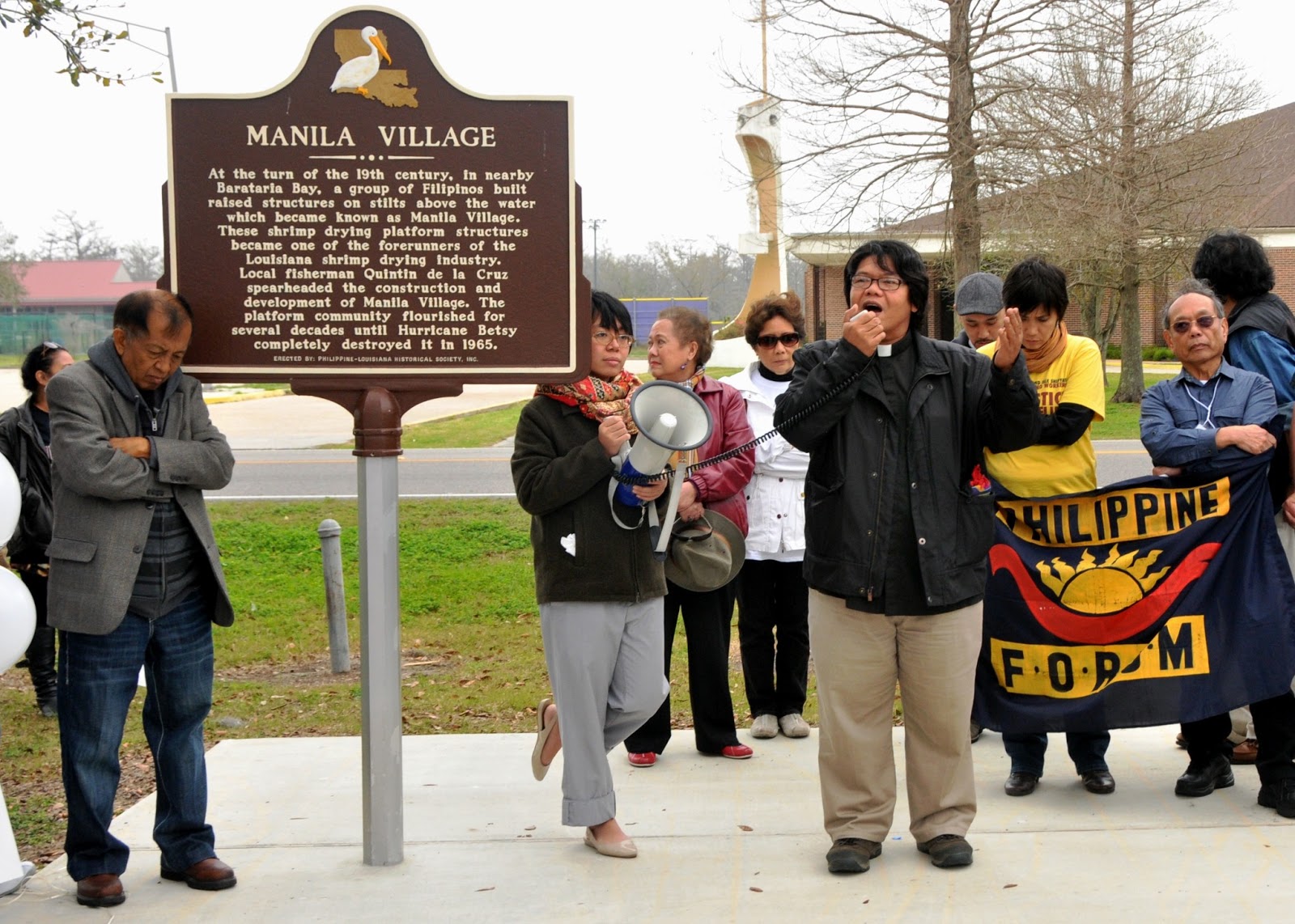
But at the Manila Village marker in front of the Lafitte town hall, Julia Camagong of the International Migrants Alliance-USA declared that “Unlike the Philippine government which has not done enough to address this issue, today is a sign of our commitment. We will not stop till justice is served for Filipino workers and all the exploited migrant workers here and around the world.”

Filipino contract workers have accused GIS of abusive and exploitative working conditions akin to slavery.


In addition to being made to work under unsafe conditions, the migrant workers alleged that they were paid approximately $5 an hour for 10-14 hour days with no overtime. They were also deducted $1000- $3000 a month for employer housing that consisted of 4-6 workers sharing a single 10 feet by 10 feet room,” said Katrina Abarcar.

“Bunkhouse lockdowns, a 10:00 PM curfew, constant surveillance from security cameras, and limited communication with the outside world were also enforced. Workers also endured discriminatory practices from their employer such as restrictions on religious practices and threats of termination and deportation if workers failed to comply with their employer’s strict rules,” she added.

The group said the Nov. 16, 2012 Black Elk oil rig explosion in the Gulf Mexico that killed three Filipino workers, helped draw international attention to the “flagrant abuses and injustices they have suffered,” Abarcar said.

The crowd, estimated at 100 was greeted by Dr. Carmelo Astilla who created the inscription commemorating one of the first settlements in the US of Filipinos who escaped from forced labor aboard Spanish galleons.

Rev. Israel Alvaran, who gave a benediction, described the trip as a “pilgrimage where we remember those who have gone before us to fight for justice.” 

“Today in 2013 we are still escaping slavery. We are still brave Filipinos, we are still proud Filipinos. It is through our organizing, our unity, and power across all communities that we will stop this from happening again,” NAFCON head Valen said.

The day was described by other supporters of the campaign such as Daniel Castellanos of the National Guestworker Alliance as “a day of unity – the day we united to defeat all bad employers like GIS.” According to Alfred Morshew of STAND with Dignity, he came out to support his Filipino brothers “because it is one system oppressing Filipinos and African Americans.”

The program ended with “Bayan Ko” led by Pendong and Chat of “Ang Grupong Pendong” and the release of 100 white balloons, symbolizing the more than 100 Filipino workers believed to still be working for GIS “under oppressive conditions who the conveners of the campaign hope to see freed”.

After the program, the caravan made an unplanned trip past a Grand Isle Shipyard site in Lafitte, and left placards with campaign slogans on the ground, including Filipinos Against Slavery and Trafficking (FAST), the newly formed workers organization in the area.

Their next stop will be Washington DC on March 17 that will include a public forum for the Washington DC., Maryland and Virginia community as well as a mobilization in front of the Philippine Embassy to demand Cuisia’s resignation.


Tuesday, February 26, 2013

IS THE U-S JOINING ANTI-VICE CAMPAIGN IN PH?


The intrepid undercover report by ABC News may have cast a dark light on the problem of prostitution in the Philippines but that’s hardly news back home where people walk by these dens, aware but powerless or, worse, ambivalent to what happens inside.

When US Ambassador Harry K. Thomas Jr. was in town, he spoke before an Asian-American forum where he sort of matter-of-factly claimed that 40 percent of American men visiting the Philippines go there for sex. A few days later an old colleague from ABS-CBN asked if he really said that. Yes, I replied but I didn’t mention it in the article I posted because I didn’t think it jumped out.

Well, Mr. Thomas repeated that allegation in Manila and it landed him in hot water. Using every trick in crisis diplomacy, he was finally able to wiggle out of the public outrage and indignation. I would imagine the angry reaction surprised him because you didn’t have to look too hard to see that what he said was true.

The ABC News report, facilitated by Fr. Shay Cullen, merely brought the problem to a larger audience.

What jumped out for me though was reading that the US Immigration & Customs Enforcement (ICE) was involved in an operation to arrest and possibly prosecute an American national, identified in the report as Arthur Benjamin of Texas.

The report suggested the feds were interested in Benjamin for allegedly having sex with a minor and operating a bar that employed underaged girls for prostitution. This sounded like a warning and a reminder to all Americans that their citizenship made them subject to US laws wherever they may be.

While the ABC News report focused on Benjamin’s alleged bar in Subic, Zambales, it’s also widely known that some of the seediest establishments in Angeles, Pampanga are also owned by Americans.

They are mostly left-overs of the US bases in those towns, where in some cases generations of girls have been trapped in the “world’s oldest profession”. Some vestiges are more personal, girls sired by US servicemen – especially at the height of the Vietnam War when Subic and Angeles City were synonymous with “R&R” – with prostitutes who have themselves been sucked into the “trade”.

Of course, much of this is fueled by poverty and corruption. Occasionally the police would raid these establishments, reporters and TV cameras in tow, especially when there’s a new commander at the post or a new face in city hall.

Scribes who pounded the community and police beats even coined a “code” for them “Oplan Pakilala” – translated as Operation Introduction – that let the bar managers know who to give the protection money (or favors) to.

There might be some questions about American law enforcers joining anti-vice operations in a sovereign country, thousands of miles away. It’s certainly embarrassing for the Philippine police. 

Prostitution has sometimes been described as a “victim-less crime” but that’s not true. Prostitution like human trafficking is an “equal opportunity crime” because it corrupts indiscriminately and so completely. And the damage is more pernicious where children are concerned.

Only recently, a federal investigation into alleged weapons smuggling from the Philippines was blindsided by revelations some FBI agents may have paid for Filipina prostitutes using taxpayer’s money as part of undercover operations.

If the charges turn out to be true – together with the assertion that its nationals are among the chief drivers of the prostitution problem in the Philippines – then the US is right to intervene. If they can send their drones to knock out terrorists – even Americans – across the globe, I don’t think too many will complain if they haul misbehaving citizens like Mr. Benjamin to jail. 

Those parts of Subic or Angeles are not much different from, say, Bangkok's Patpong or any other notorious (or "popular"?) red light district in the world. They hardly represent the country or even the cities where they’re located. Still, they taint Filipino women. 

Mr. Thomas has promised US help to prosecute Americans involved in the sex trade and human trafficking in the Philippines. We hope that in addition to aiding local law enforcers, they would also help groups like those of Fr. Shay who has spent a lifetime helping young Filipinos.


Tuesday, February 19, 2013

WHITE HOUSE NEEDS A 'BRAT PACK'


I thought this morning’s news was somewhat amusing. The White House press corps was up in arms over the weekend after they weren’t granted a photo-op of President Obama playing golf with Tiger Woods in Florida.

It has spawned a host of articles – one calling Obama a “puppet master” for purportedly manipulating the press – disconcerting only because there was a flood of “serious” matters that begged discussion from the White House.


There was for instance the “leaked” immigration reform legislation that the President would reportedly push forward to Congress if the current bipartisan efforts of the “Gang of 8” fail to take off. That drew a quick rebuke from lawmakers, prompting the White House to deny it was behind the leak.

From experience, reporters covering Presidents appear to be more sensitive and zealous about access to their primary news source. During the Aquino I administration, Palace scribes were christened the “brat pack” for reasons that were only too obvious for “Tita Cory’s” media handlers.

They would complain constantly, berate, cajole, threaten and humor their way to a story. But they got the story out.

When Aquino II spokesman Edwin Lacierda visited Washington DC sometime back, we asked him about complaints from some in the Malacanang Press Corps about his boss’s emasculated calendar that apparently left few opportunities for reporters to submit a copy that at least had an even chance to make the front page.

He insisted that the President has a packed schedule that isn’t always reflected in the calendar handed out to the press.

Fox News’ Ed Henry, who currently heads the White House Press Corps, stressed that their beef with President Obama wasn’t about the golf game. But it’s raised eyebrows from others.

Conservative columnist Charles Krauthammer blasted the media for what others have described as “whining”, calling it “the biggest non-story” since the Kardashian weddings.

“If the guy wants to play golf, the guy deserves a couple of days off. He wants privacy — big deal. I don’t understand what the story is and what the outrage is,” he said on Fox News.

“You want to watch him shank and slice?” he added. “What we’ll do is look at his score card and that’s enough. I don’t think Obama’s out there with Tiger receiving marital advice. I think he’s out there receiving advice on how to line up a putt.”

“The balance of power used to be much more in favor of the mainstream press,” Mike McCurry, who was press secretary to President Bill Clinton during the Monica Lewinsky scandal was quoted on Politico.com.
The website’s highly cited Jim Vandehei and Mike Allen observed, “The president has shut down interviews with many of the White House reporters who know the most and ask the toughest questions. Instead, he spends way more time talking directly to voters via friendly shows and media personalities. Why bother with The New York Times beat reporter when Obama can go on ‘The View’?”

Technology has helped transform those dealings today, especially with the wider use and growing reliance on social networks as well as blogs.

The White House, according to Politico.com, “has taken old tricks for shaping coverage (staged leaks, friendly interviews) and put them on steroids using new ones (social media, content creation, precision targeting). And it’s an equal opportunity strategy: Media across the ideological spectrum are left scrambling for access.”

Perhaps these are straits only journalists on the presidential beat can appreciate (or be so enraged and indignant). So to them, our unsolicited advice is “it’s alright to be a brat”. 

Monday, February 18, 2013

SEQUESTRATION IS COMING, FIL-AMS BRACE FOR CUTS


“It’s going to happen,” said Congressman Jim Moran, a Democrat representing our district in Northern Virginia. Although he was at T.C. Williams High School (yes, “Remember the Titans” starring Denzel Washington) to talk about student aid, the looming sequestration was felt even there.

In his State of the Union address, President Obama warned of “grave consequences” if the sequester happens. Unless Congress acts, a series of automatic cuts – the sequester totaling $1.2 trillion spread over a decade – will take effect on March 1, about two weeks away.

It will impose drastic cuts in defense and domestic programs. The White House said the cuts could eradicate thousands of jobs for teachers, federal law enforcers and prosecutors; raise the possibility of food-borne epidemics; dry up about $540 million in loan guarantees for small businesses; and throw about 100,000 previously homeless people, including veterans, back out in the streets, among others.

The Budget Control Act of 2011, which created the sequestration, immediately lopped off $400 billion from the Pentagon budget and set the stage for slashing another $600 billion.

So why should we be concerned? The non-partisan Congressional Budget Office (CBO) warned last week that as many as 750,000 jobs could be lost this year.

Sequestration would have a major impact in the Metro DC region, as well as the rest of Virginia and Maryland with its army of defense contractors and military facilities.

Lockheed is based in Bethesda, Md.; Northrop Grumman and General Dynamics HQs are in Fairfax, Va.; and SAIC is in McLean, Va. Among the four of them, they lassoed nearly $100 billion in defense contracts in 2010.

Hundreds of Fil-Ams are employed by the federal government; thousands more work for companies or own enterprises that rely heavily on it, especially the military. The Philippine American Chamber of Commerce in Washington DC, for instance, has organized panel discussions on the impact to small businesses of Obama initiatives, including the upcoming implementation of “Obamacare” this year.

Still, Peter Singer of from the Brookings Institute, writing for Time, said the overall impact of the sequestration would not change the balance of power or America’s standing in the world. “The US is the only global superpower, with capabilities and responsibilities that dwarf any and every other state in the world,” he wrote.

GOP congressmen have signaled they would be ready to accept deep cuts in the defense budget if only to force Democrats to accept cuts on popular social programs as well.

The whole law was premised on shared pain, that slashing defense and domestic programs would be too painful for Republicans and Democrats alike that they would be forced to compromise. If the sequestration does push through, it will show pain is not as potent a stimulus as they thought it would be.

President Obama telegraphed his reluctance to touch entitlements, and appeared bent on pushing the GOP to accept more revenue-raising measures like plugging tax loopholes. Oklahoma Rep. James Lankford, chairman of the Republican Policy Committee, said after the President’s address that there’s now a greater chance the sequestration will happen.

There is simply no bipartisan solution out there.

Now federal agencies, including the Pentagon, are busy preparing for it. Managers all across the vast federal bureaucracy have been briefing employees about furloughs, contingency plans ready.

With Congress on vacation until next week, many believe there won’t be time to stop sequestration. If it’s inevitable, I guess it’s imperative for Congress to rationalize sequestration, to control the descent so it doesn’t crash the economy.

Sequestration, Stinger said, “would be a terribly stupid thing to do.”

“It not only wouldn’t solve the core problems driving the US debt,” he added, it would also cut the budget in an “un-strategic manner…cutting both the good and bad by the same portions with no planning.” 

But what’s more disconcerting is the realization this is just the first in a series of events – raising the debt ceiling and crafting the national budget have to be tackled in the next two months. It's going to be difficult and the circus just doesn’t seem to want to leave DC.


Tuesday, February 12, 2013

PINAY NURSE IS OBAMA GUEST IN STATE OF UNION ADDRESS


Filipina nurse Menchu Sanchez gets a rare vantage view of President Obama’s State of the Union address before the joint session of Congress.

The Secaucus, NJ resident has been hailed as one of the heroes when Hurricane Sandy devastated large parts of New York and New Jersey last year.

After surging water took out the electricity at New York University’s Langone Medical Center, Sanchez, 56, organized the ICU doctors and nurses to carry 20 critically ill infants down nine flights of stairs with only cellphones to light the way.

“Even as Menchu’s own home was flooding, she thought only of protecting the babies in her care,” the White House explained in a statement.

She was invited by the First Lady Michelle Obama to be one of her guests, who’ll be sitting in the balcony that overlooks the podium delivers the State of the Union address. 

“I’m very excited,” she was quoted on northjersey.com. “This is a dream come true for most people — to meet the president — and I never thought I would get this chance. I voted for him twice and I’ve been following Michelle Obama’s philosophy for years as first lady. I can’t wait.”

She wanted to wear her best “terno”, the traditional dress she wears for socials with the Fil-Am community, but was told to “dress simply”.

Sanchez was born, raised, and educated in the Philippines and she immigrated to the United States in the 1980s.  She has worked as a nurse in New York for more than 25 years, and has been at NYU since 2010.  

When her family heard she was being invited to meet President and Mrs. Obama, her 19-year-old daughter asked to take the place of her father.

The other guests of the First Lady include Alan Aleman, an undocumented immigrant from Mexico City. He is one of the so-called DREAMers who were brought to America as infants or young children by parents who were undocumented aliens.

In high school, Alan watched his friends come of age – driving around town with their new licenses and earning some extra cash from their summer jobs at the mall, knowing that his status prevented him from those activities.

But when he heard about news that the Obama Administration was going to provide Deferred Action for undocumented youth like him to emerge from the shadows, he was one of the first to sign up, the White House said.

 Alan is in his second year at the College of Southern Nevada.  He’s studying to become a doctor and he hopes to join the Air Force.  Alan is currently working at Hermandad Mexicana, where he is in charge of final review for DACA applications. 

Also with the First Lady are Cleopatra and Nathaniel Pendleton, whose daughter Hadiya was murdered on January 29, 2013, when she was shot and killed in Harsh Park on Chicago’s South Side.

Hadiya had participated in President Obama’s public inaugural celebration on January 21, 2013.  The honor student and band majorette at King College Prep High School has become another symbol of the victims of gun violence in the country. 

Mrs Obama attended Hadiya’s memorial service last Saturday.

Sunday, February 3, 2013

WAITING FOR HILLARY


Hillary Clinton bid farewell to the State Department last Friday, amid chants of “2016! 2016!” A large crowd, workers and well-wishers together, gathered at the agency’s main lobby in Foggy Bottom – among them Filipinos who are among her loudest cheerleaders.

In the 4 years she served as America’s top diplomat, Clinton traveled nearly a million miles (enough to span the globe more than 38 times) visiting 112 countries, including the Philippines.

Foreign Affairs Secretary Albert del Rosario had earlier flown to Washington to confer the Philippine Legion of Honor to Clinton – a rare award only given with the consent of the Congress and previously bestowed on President Franklin D. Roosevelt, Gen. Douglas MacArthur and more recently, the late Sen. Daniel Inouye of Hawaii.

Clinton was one of the Philippine’s staunchest supporters, from the East Philippine Sea dispute with China to speaking out against those who would subvert democracy there.

 
Little wonder her Filipino supporters here said they’re ready to swing into action if she does decide to throw her hat in the next presidential elections in 2016. In the days leading to her retirement, she was asked constantly about her plans but she demurred. She would wake up late this weekend, Clinton said, and a bit later, explore the horizons and do a “lot of talking and writing”.

“I sent her flowers,” New York-based Fil-Am leader Loida Nicolas Lewis told us after a health scare when she collapsed and doctors found a clot in her head that was eventually removed without surgery.

“We’re staying back and waiting for her to make a decision without any pressure,” Lewis said. She actively campaigned for Clinton during the 2008 Democratic nomination race that then Sen. Barack Obama won.

“Secretary Clinton strongly supported the Philippines’ advocacy for a rules-based approach in resolving competing claims over maritime areas through peaceful and diplomatic processes within the framework of international law,” a statement from the Philippine Embassy said.

The statement continued, “In September 2010, President Benigno S. Aquino III and Secretary Hillary Clinton unveiled the $434 million Millennium Challenge Account (MCA) Compact aimed at reducing poverty through economic growth in New York.

“Secretary Clinton oversaw the Obama administration’s pivot to Asia and reaffirmed the strong military relationship between the US and the Philippines. With Secretary Del Rosario, Secretary (Voltaire) Gazmin and Secretary (Leon) Panetta, they held the first Philippine-US Two + Two Ministerial Consultations in April 2012, providing the framework for intensified dialogue and cooperation on defense and security issues.”

Clinton responded by “reaffirming the US government’s commitment to strengthening the Philippine defense capabilities”.

While the official Philippine account enumerated the tangible effects of Clinton’s efforts to promote the country’s interests in the Obama administration, supporters here say it’s the ones that can’t be spoken about that really bore the heavier impact.

When in 2009 rumors swirled in Manila that then President Gloria Macapagal Arroyo would try to “steal” the 2010 presidential elections by manufacturing a national emergency, a delegation of Fil-Am community leaders sought and got a public assurance from Clinton that the US frowns on any plot to block elections, virtually warning off the Arroyo administration. 

And when Del Rosario flew here following confrontations with China over a lingering territorial spat, Clinton laid down the US position – the strongest assurance given yet for its longstanding treaty ally.

She also demonstrated her brand of diplomacy during a visit to the Philippines, acting like a candidate campaigning for Filipino votes than the 4th highest ranking official in the US government.

But while she seemed to relish shaking hands with ordinary folks, Clinton was also quick to slap those of offenders – speaking out against extrajudicial killings, abuses and human trafficking, and threatening to pull out the US aid they coveted, not so much for the cash infusion as the stamp of approval and political legitimacy it connotes. .

Clinton has built a legion of Filipino admirers here and in the Philippines, including Lewis who says she still hopes Clinton would become the 1st female president of the United States.


Saturday, February 2, 2013

MORE FIL-AMS VOTED FOR OBAMA IN 2012 - POLL


Filipino American voters broke more heavily for President Obama during last year’s re-election victory than his more historic 2008 win, an exit poll by the Asian American Legal Defense & Education Fund (AALDEF) revealed recently. 

The exit poll showed 65 percent of Fil-Ams voted President Obama to a 2nd term in the White House; 32 percent voted for his Republican rival Mitt Romney’s in last November’s presidential elections.

The President thus fared much better than the 50 percent of Fil-Am voters he won over versus the 46 percent of his GOP rival Sen. John McCain in the 2008 elections.

The result surprised many in the Fil-Am community because a separate survey done about 2 months before the November 2012 polls showed that likely Fil-Am voters were leaning more for Romney, 39 percent compared to the President’s 33 percent.

The dramatic shift could be attributed in part to the aggressive voter registration campaign that appeared to have favored Democrats than it did for GOP candidates. The AALDEF exit poll revealed that 23 percent of Fil-Ams who cast a ballot last November were 1st time voters.
 
Fil-Am voters tracked closely with the overall results of the Asian American vote. The AALDEF poll showed about 77 percent of Asian Americans voted for President Obama, with the biggest majority posted by Bangladeshi Americans at 96 percent. The President lost only among Vietnamese Americans at 44 percent.

Of the Fil-Am voters polled, 52 percent identified themselves as Democrats, 26 percent Republicans and 18 percent as Independents.

"Asian Americans are a diverse community with varying social, political, and economic backgrounds," said AALDEF Executive Director Margaret Fung. "The AALDEF Exit Poll provides much needed data on Asian American voting trends, especially as our community's political influence continues to grow."

Glenn Magpantay, AALDEF Democracy Program Director, explained that the survey covered Asian American voters in 37 cities across 14 states on Election Day – New York , New Jersey , Massachusetts , Pennsylvania , Virginia , Maryland , Michigan , Illinois , Georgia , Louisiana , Florida , Texas , Nevada , California , and Washington D.C.

The largest Asian ethnic groups in the exit poll were Chinese (31%), Asian Indian (13%), Bangladeshi (12%), Vietnamese (12%), Korean (11%), Filipino (9%), Pakistani (3%), Arab (2%), Indo-Caribbean (1%), and Cambodian (1%).

Among their findings:

Location appears to matter. President Obama won big in the northeastern states (e.g. 89 percent in Pennsylvania and 86 percent in New York and Michigan ) and fared more poorly in the South (e.g. 57 percent in Texas and 16 percent in Louisiana).

The generational divide that marked the President’s 2008 victory appeared to continue in 2012. Only 10 percent of Asian Americans under 30 voted for Romney (he best performed in the 60-69 age bracket at 27 percent). Asian Americans under 40 broke heavily for the President.

The large number of 1st time voters appear to reinforce the notion Asian Americans are a growing segment of the electorate. About 79 percent of Asian Americans polled were foreign born. More than 27 percent of those polled said they voted for the 1st time last year.

Support for comprehensive immigration reform was overwhelming. About 34 percent of Asian Americans polled said they “strongly support” and 31 percent “support” comprehensive immigration, including a path to citizenship for undocumented immigrants. The support is highest among Bangladeshi Americans at 78 percent and lowest among Vietnamese Americans at 49 percent.

When asked how the candidates stacked up against major issues, Asian American voters polled said they favored President Obama on healthcare, immigration and women’s issues; they favored Romney on the jobs and security issues.

In 24 of the 28 Congressional districts where the exit poll was conducted, a majority of Asian Americans supported Democratic candidates.

For the US Senate, 74 percent of Asian Americans overall voted for the Democratic candidate and 18 percent voted for the Republican candidate. For the US House of Representatives, 73 percent voted for the Democratic candidate and 17 percent voted for the Republican candidate.

In Virginia , Democratic senatorial candidate Tim Kaine got 70 percent of the Asian American vote compared to his GOP rival George Allen’s 26 percent. Kaine won the election.

AALDEF has conducted exit polls of Asian American voters in every major election since 1988. In the 2008 Presidential Election, AALDEF surveyed 16,665 Asian American voters in 11 states.

More than 100 community groups and organizations joined AALDEF to mobilize over 800 attorneys, law students, and volunteers to conduct the exit poll and to safeguard the voting rights of Asian Americans. 


Friday, February 1, 2013

CHEERING FOR THE ‘BLUE-EYED BOY’ OF ASIA


When last we talked, I asked Prince, my grandson, what he wanted for his birthday which is a few weeks away. I thought he’d finally outgrown his Schleich menagerie and moved on to Lego’s. So I planned an expedition to the nearest Toys R Us so I can Johnny Air it early to Manila until my son suggested that we just pick out something on the net, send the money and he’d buy it for us. “We have everything here now,” he assured.

I suddenly remembered how that struck me during our short visit to Manila the other year – the sheer abundance and variety of wares in stores that’s sprouted like mushrooms.

A Bloomberg report said strong consumer spending will fuel the Philippine economy this year and help make up for lower exports that’s being felt all around the region.

It cited World Bank data showing consumer spending growing vis-à-vis the country’s GDP which it attributed to foreign remittances, income from the flourishing BPO sector as well as a burst of manufacturing from Japanese investment. The Philippines is reportedly on the way to boasting the 2nd best performing economy in the world, next only to China (which is showing signs of slowing down, according to some economists).

Standard & Poor’s raised the Philippine’s sovereign rating outlook to positive, moving it closer to achieving the coveted investment grade this year (as some experts predict). “The Philippines,” Bloomberg quoted Singapore-based economist Vishnu Varathan, “is on a very good footing to remain the blue-eyed boy in the region.”

Ever the sharp money-man, Ambassador Jose Cuisia Jr. boldly told us during a pre-Christmas get-together at the Embassy’s Romulo Hall that the Philippine economy would grow “closer to 6 ½ percent” after the World Bank had just revised their Philippine projection from 5 to 6 percent. I should really start taking some bets from him – the economy actually grew by 6.6 percent according to the Finance Department – which makes Cuisia a prophet of sorts?

He said the Philippine stock market posted 37 record highs in 2012 (at least as of last December). “When I left the Philippines in April 2011, the index was 3,200; today, it’s about 5,700 which means 20 percent a year for the past 2 years and that’s why it’s one of the best performing markets,” he explained.

Still, I wondered aloud if it wouldn’t be better if at least the better part of that growth came through investments, foreign and domestic?   Even amid the flood of good news, the Philippines continues to lag behind its Southeast Asian neighbors in terms of Foreign Direct Investments (FDI) – the “good investment” in contrast to portfolio investments or “hot money” that can move out of the country just as quickly as it goes in.

Although FDIs grew over 10 percent in the first 6 months of 2012, the United National Conference on Trade & Development observed it was much lower than the rest of Southeast Asia (e.g., $900 million FDI for the Philippines vs. $27 billion for Singapore or $8 billion for Indonesia, $6 billion for Thailand, $4 billion for Malaysia).

Cuisia said FDIs are preferable because they translate into new factories and businesses that generate jobs and revenues over the long term. “The Philippines needs to attract much higher levels of FDIs in order to achieve its goal of sustained, inclusive high growth rates,” said economist Benjamin Diokno of the University of the Philippines. To do that, experts say, the country needs to level the playing field (which entails constitutional changes).

Moreover, a consumer spending-driven economy is good and pretty only for people who’ve got money to spend. The IBON Foundation in Manila estimates more than 4 million Filipinos are jobless and another 7 million earn wages that is barely enough to support a typical family of six in Metro Manila. And the number of working-age Filipinos is expected to hit 75 million by 2020. Those Filipinos need jobs, decent-paying jobs.

Watching from across the continent, the feats of the last couple of years – particularly under President Noynoy’s watch – is a source of pride (if we can cheer for Manny Pacquiao or Jessica Sanchez, shouldn’t we do it here as well?). It shows Filipinos can be great achievers, able to compete with the best in the world and meet the rigors of nation building.  

But if President Aquino aspires for greatness – as all leaders should – his legacy will be defined less by how much the GDP grew than by how many lives were made better by it. The challenge is how to ensure its fruits are spread to the greatest possible number of Filipinos. And how it can be sustained passed generations, and perhaps more daunting, passed the nation’s future leaders. 

I wish this not for myself but for Prince and Paulo.


Thursday, January 31, 2013

UNEARTHING THE FILIPINO PIONEERS OF ANNAPOLIS


What started off as a summer archeological expedition by University of Maryland graduate students in Annapolis has unearthed artifacts that's provided a glimpse of early Filipino settlements in the East Coast.

The migration of thousands of Filipino farm workers and laborers to Hawaii and the West Coast in the early 1900s is well-documented. PBS recently produced a documentary about how some Spanish galleon crew members jumped ship in the 1760s and formed a Filipino hamlet in the Louisiana bayous – where their descendants still live today, making them the oldest continuous settlement of Asians in America.


(Photo from UMD archive)

But little is known about the Filipinos who opted to trek east. That’s why this UMD project, led by archeologist Mark Leone and Fil-Am graduate student Kathrina Aben, feels so exciting to me.

They have already dug up old homes in Annapolis, the seat of Maryland and home to the US Naval Academy which is where this tale starts.

Commodore George Dewey spent just a couple of hours demolishing the Spanish flotilla in Manila Bay, paving the way for US conquest of the islands. There they found an abundance of skilled manpower, recruiting Filipinos to be interns, firemen, construction workers, cooks and the innocuous stewards (a job description that would take early Filipino immigrants all the way to the White House).

Aben believes as many as 200 of them were brought to Annapolis in the early 1900s (by 1915 or 1916, she said some Filipinos actually got to study in the Naval Academy).

The Filipinos’ arrival raised tensions in the community, she revealed, because of perceptions they were out to steal jobs from Whites and that era’s other minority group, the African Americans. In fact, it was this conflict that first drew the attention of UMD researchers.

Some of those early Filipino settlers are apparently still alive and have been interviewed by the students. Aben reported that their testimonies revealed the deep racism – even violence – and discrimination they endured but also somehow overcame.

They formed clubs, opened restaurants which advertised “Hawaiian food” even though the food was unmistakably Filipino (patrons probably didn’t know any better) and engaged in sports.

Many ended up marrying Black women because in the 19th to early 20th century there weren't many Filipinas in the East and perhaps more significantly, African Americans and Filipinos faced similar discrimination from the White-dominated city.  Those who refused to be tied by those restrictions, moved to other states where they could love any woman.

Another group of UMD students are conducting an archeological dig at the home of James Holliday, a former slave who purchased the property on 99 East Street in 1850 and passed it to descendants, who’s believed to include granddaughter Eleanor Briscoe Portilla – who married Filipino cook Cosme Portilla in 1919.

The dig has revealed dressmaking supplies, toys and other relics. The excavation has already altered conventional understanding of that community, that it was upper class and white. It now appears to be more diverse, a place where Filipinos, African-Americans and Jews lived in close proximity of each other.

Aben hopes further finds could shed more light on those Filipino pioneers. "This research remains relevant and important to the Filipinos still living in Annapolis and the overall Filipino diaspora in the US.”

All the time and resources UMD is investing in this endeavor can be taken as indication of the impact these early Filipino settlers had on Annapolis and indeed on the state itself. It’s a story that’s still unraveling. But I’m just curious, where else will we find relics left behind by early Filipinos in America?


Wednesday, January 30, 2013

THE LONG, TOUGH PATH TO CITIZENSHIP FOR UNDOCUMENTED IMMIGRANTS


“Now’s the time,” President Obama declared as he unveiled his vision of immigration reform in Las Vegas the other day.

Just a day earlier, a bipartisan group of senators – the “Gang of Eight” – bared their blueprint for comprehensive immigration changes. It was, according to Politico.com, the biggest bipartisan push since an earlier attempt died in the Senate in 2007.

Last year’s elections cast the die for Congress to finally tackle immigration reform. Latinos (75 percent) and Asians (77 percent) helped fuel Obama’s win over GOP rival Mitt Romney – and where they mattered, paved the way for Democratic victories in congressional races.

The Asian American Legal Defense & Education Fund (AALDEF) exit poll showed 65 percent of Fil-Ams went for the President – bigger than the 50 percent who voted for him in 2008 – despite earlier projections Fil-Ams were leaning towards Romney.

And for these voters, comprehensive immigration reform was a major concern: about 34 percent of Asian Americans polled said they “strongly support” and 31 percent “support” comprehensive immigration, including a path to citizenship for undocumented immigrants (another survey suggested 51 percent of all Americans held a similar sentiment).

The Republican Party has often been vilified in the immigration debate. Their vehement opposition to any form of amnesty, including the DREAM Act and opening a path to citizenship, has eroded support among minorities. The recent election results appear to buttress this.

The GOP is trying hard to reconcile with the changing demographics. Many party stalwarts see immigration reform as a way of regaining relevance. Still, while the Senate looks ready to work on an immigration bill, the House, with its tea party constituency, could slog its way to the finish line or another debacle.

The “Gang of 8” proposal would overhaul the legal immigration system and create a pathway to citizenship that is being tied to more effective border enforcement. It would expand e-Verify and stiffen penalties for violating businesses.

“Of particular interest to the Filipino American community is ensuring that earned citizenship is available for DREAMers, decreasing the backlog in the family-sponsored immigration system, especially for Filipino World War II veterans, and promoting immigrant integration in the community,” said KAYA spokesperson Melissa Josue.

Like most minorities, Fil-Ams view immigration reforms from different prisms. There is the generational divide. The DREAM Act aims to legalize the stay of young undocumented immigrations brought here by parents who may be undocumented themselves.

Others, as Melissa mentioned, are more concerned how reforms can erase the huge backlog of petitions for love ones left behind in the Philippines – a waiting period of at least 24 years for married sons and daughters for instance.

About a third of Fil-Ams are opposed or have no position on immigration reform (compared to 43 percent of Chinese Americans), according to the 2012 AALDEF exit poll.

Speaking with some of these skeptics, I found a common anxiety, a fear that ill conduct might be rewarded.  “Why should those who ‘jump the line’ be rewarded at the expense of those who’ve followed the rules and are still waiting for the opportunity to come and live in America?” they asked.

Republicans want to establish a committee that will give the green light when the border with Mexico is “truly secure” and trigger mechanisms to open the pathway to citizenship for about 11 million undocumented immigrants. And there lays, as political pundit Roger Simon coined it, the “900-pound immigration gorilla”.

Democrats are wary. President Obama has said undocumented aliens can work their way to earn American citizenship by paying taxes, obeying laws, settling fines and perhaps most importantly, for them to go back at the end of the line. That has to be the key.

It’s become apparent, especially during his inaugural address, that the President views comprehensive immigration reform as part of a wider social justice agenda. It’s about sharing a slice of the American Dream, it’s about fairness, it’s about taking the best and brightest and putting them to work here, it’s about re-uniting families.

But if all that doesn’t work, we can always revert to the cold reality of the prevailing political calculus. As New York Sen. Chuck Schumer put it – “There’s more political risk in opposing immigration reform than supporting it.” So here’s to 2014.


Tuesday, January 29, 2013

THE FLOUNDERING GUARDIAN


I guess it’s safe to say Lt. Cmdr. Mark Rice won’t be stepping aboard the bridge in the foreseeable future, unless of course he was being forced to walk the plank.

He was the skipper of the USS Guardian, a sophisticated mine-hunter that ran aground on Tubbataha Reef last Jan. 17, allegedly a victim of faulty satellite-produced maps.

She’s been stuck there ever since, her fiberglass-reinforced wooden hull punctured by the razor-like corals and taking in water; a bogey for conservationists and militants in Manila and worse – at least for the US – an embarrassment for what is arguably the most advanced navy in the world.

I can almost see the grimace from my navy friends when they see the report on ABC News today that the US Navy will cut her up so she can be removed from the reef, a marine sanctuary and UNESCO World Heritage Site.

My navy friends – still pining for the days when the Philippines rode high across our seas – can only forlornly look as the 23-year-old Avenger-class minesweeper (a virtual infant by Philippine Navy standards) is destined for the scrapyard.

US 7th Fleet spokesman Capt. Darryn James was quoted by ABC News that cutting the ship into pieces was the only way to get it out without further hurting the reef – which experts say has already suffered significant damage. Two heavy-lift ships will take about a month to extricate the stricken Guardian.

On the one hand, this is testament to America’s fealty to the environment. “I greatly regret any damage this incident has caused to Tubbataha Reef,” said Vice Adm. Scott Swift, commander of the US Pacific Fleet, “We know the significance of the Tubbataha Reefs Natural Park and its importance as a World Heritage Site. Its protection is vital and we take seriously our obligations to protect and preserve the maritime environment.”

But according to the US Navy’s own assessment, the ship was so badly damaged that forcibly tugging it from her coral perch might have broken her up anyway.

How can the Guardian’s master, with all the electronics aboard – including presumably the latest sonar technology which is the bread-and-butter of any anti-mine warfare vessel – have gotten it so wrong?

At the peak of the Philippine Navy in the 1960s and 1970s, my navy friends told me that they frequently bested their US Navy counterparts during “war games” held in waters that China now insists is theirs and theirs alone.

Filipinos, they boasted, have sharper seamanship skills. I’m not sure if our Malayo-Polynesian DNA had anything to do with it; but chatting with former Navy chief Vice Adm. Alex Pama in Falls Church last year, I got the impression that these skills – more than anything else – is what they wanted to recapture as they modernize.

Poor seamanship could have led the Guardian to sail too close to Tubbataha Reef, with its breathtaking atolls, coral walls and migratory marine life, perhaps like the moth lured by the flame.

Experts say about a thousand square meters of the sanctuary has been damaged by the Guardian, although that is largely a “guesstimate” at least until the Guardian can be extricated. The US will be fined P25,000 (about $6,100) for each square meter of affected coral plus P300,000 (about $80,000) for trespassing on the marine sanctuary. Under Philippine laws, destruction of the reefs also carried a prison term of 3 to 6 years but the government agreed not to invoke that proviso.

The incident is a litmus test for the two longtime allies, especially as the US executes the pivot to Asia. In an exercise of cost-benefit analysis, what is the price of the America’s mantle of security for countries like the Philippines that stand vulnerable to China’s bullying on her western frontier – the South China Sea?  

It may just be a case of a ship stuck on precious real estate but the Guardian mishap has revealed the delicate dance the Philippines must do to keep its seas.