Thursday, April 4, 2013

A-P-I-A PROTEST SET VS CAPITOL HILL PLAN TO STOP SOME FAMILY IMMIGRANTS


Asian Americans are gearing up for a large immigration reform rally on Capitol Hill next week that will focus opposition on an alleged plan by lawmakers to eliminate family-based visa petitions by US citizens.

Various Fil-Am groups are already mobilizing for the rally scheduled on the West Lawn of US Capitol building from 3-6 PM on Wednesday, April 10.

Two groups – the umbrella National Federation of Filipino-American Associations (NaFFAA) and Washington-based Migrant Heritage Commission (MHC) are urging Filipinos to come out strong for the mass action organized by the Asian American Justice Center, among others.

Anxiety is sweeping the Asian American community because they place heavy premium on the ability to bring relatives to the US. A recent study by the Migrant Policy Institute (MPI) showed over 4 million people have approved petitions for legal permanent residence – mostly from family-based visa categories – but can’t come over because their priority dates have not become current.

Next to natives of Mexico, Filipinos have the longest waiting time that in some categories stretches to over 20 years.  The MPI estimates that based on current quota levels and assuming there are no new petitions filed, it will take the government 19 years to clear this backlog.

Some conservative senators now apparently believe the way to solve the backlog is stopping certain family petitions by American citizens altogether.

Republican Sen. Lindsey Graham, part of the so-called Gang of Eight bipartisan group crafting a proposed immigration reform bill in the Senate said “green cards” should be reserved for the “nuclear family”.

“This is not a family court we’re dealing with here. We’re dealing about an economic need,” he was quoted by the Associated Press. Some say this could eliminate visa categories for adult and married sons and daughters as well as siblings of American citizens.

In California, Asian American groups gathered in Los Angeles’“Filipinotown” to press demands Congress strengthen family reunification as part of a comprehensive immigration reform deal. 

“The immigrant community has made it clear that they want Congress to act on immigration reform now,” said Stewart Kwoh, executive director of the Asian Pacific American Legal Center.

“Our community calls on Congress to protect and affirm family unity in immigration reform legislation. Brothers, sister and adult married children are our family members and must continue to have a path to family reunification,” he stressed.

“We need immigration reform that reunites immigrant families, including LGBT families for the long-term social and economic vitality of our nation,” declared Rep. Judy Chu (27th Dist, CA).

“Family is a cornerstone American value and our nation will be stronger if family unity is protected and strengthened in immigration reform legislation,” she argued.


“We have a historic opportunity to finally address the broken immigration system. For decades waiting has become synonymous with the word immigration to many Filipino families,” said Cynthia Buiza of the Filipino Migrant Center.

“Any immigration reform will not be complete without maintaining the integrity of the family immigration system. Let us put an end to the injustice of waiting,” she exhorted.

Advocates say Graham’s proposal would run counter to the fundamental premise of the Immigration and Nationality Act of 1965 which prioritized families as well as skilled labor in extending residency.

They also see this as further proof that some lawmakers still don’t get why immigration reform is so important for many Americans.


Wednesday, April 3, 2013

FIL-AM MEDICAL MISSIONERS QUESTION P-R-C FEES FOR ABSENT LICENSES


The initial wave of medical missioners are beginning to return from the Philippines where authorities have started enforcing new guidelines – revised after an uproar from Fil-Am doctors – but as they are wont to say, the prognosis is not good.

One team of Chicago-based medical practitioners struck the apparent confusion over new rules by the Philippine Professional Regulatory Commission (PRC) requiring Balikbayan medical practitioners to renew their Philippine licenses so they can render free medical services for indigent Filipinos, mostly in the countrysides.

“I applied for license renewal in 2011 for the Vigan (Ilocos Sur) mission and applied again for this mission, costing me $160 yet I did not get my license due to the requirement just promulgated by the PRC that I should be a citizen,” Dr. Simeon Sevandal, president of the Philippine Medical Association in Chicago wrote Asst. Sec. of Health Madeleine Valera who oversees foreign medical missions in the Philippines.

“They did not refund me the amount I paid,” he complained.

This was apparently not an isolated incident. Sevandal revealed that three other doctors in his group also didn’t get their license renewals. “We had to pay for special permits because of this,” he added.

They conducted the free medical, surgical and dental mission in Surigao City and at least two other towns of Surigao del Norte last Jan. 21-25.

Their group included six surgeons, five OB-GYN specialists, four anesthesiologists, two psychiatrists, three general internists, three pediatricians, five family medicine practitioners, three dentists, 12 nurses, a pharmacist, nutritionist and an optometrist, among others.

Sevandal said they were assisted by other medical professionals from the Armed Forces, Department of Education, the Caraga Regional Hospital and the Gigaquit District Hospital.

All together he counted 79 medical volunteers, 54 of whom came from the US.

“We were able to attain our objectives but the follow-up of patients will be the problem,” Dr. Simeon Sevandal, president of the Philippine Medical Association in Chicago, wrote in an email shared with this blog.

“The deficiency lies in the local health clinics. We were informed by our patients in the outreach that they would not be able to get medicines for the chronic conditions especially for diabetes, hypertension, asthma etc.,” he explained.

He said they performed 43 major surgeries, 67 minor surgeries, 629 dental extractions, saw or treated over 5,000 patients, gave away 2,000 pairs of reading glasses and hundreds more of toothbrushes and toothpaste – luxuries for many in the province.

In the end, the medical missioners felt overwhelmed by the people’s needs. “Our group can not shoulder all the expenses and time needed to alleviate the condition of our people,” Sevandal lamented to Valera.

“Since we are paying for our license renewal and special permits to the PRC, this agency should share the money earned from this venture,” he proposed.

“You can just imagine the amount of money they were able to get from us for license renewal and special permits. I think we should ask congressmen who have pork barrel funds to share with local health clinics…If they are not willing to do this then they can pass a bill in Congress to allocate funds for these local health clinics,” Sevandal added.

Every year, dozens of Fil-Am medical groups from all over the US fan through the Philippines to treat indigent Filipinos, paying for their own tickets and accommodations while in the country. They are sometimes joined by American colleagues. Many bring donated supplies or used medical equipment from their hospitals.

Most of them say it’s their way of giving back to the mother country but some also added, authorities shouldn’t make it more difficult for them to pay their good fortune forward.


Tuesday, April 2, 2013

A ‘VERY, VERY IMPORTANT RELATIONSHIP’ AS INTERESTS CONVERGE


State Secretary John Kerry left no room for doubt about America’s affinity for the Philippines, describing it as a “very, very important” ally.

I guess in diplomatese that could translate to a “major, major friend” in the Asia-Pacific where the US is in the midst of a strategic “re-balance”. He wasn’t just buttering up to visiting Philippine Foreign Affairs Secretary Albert del Rosario.

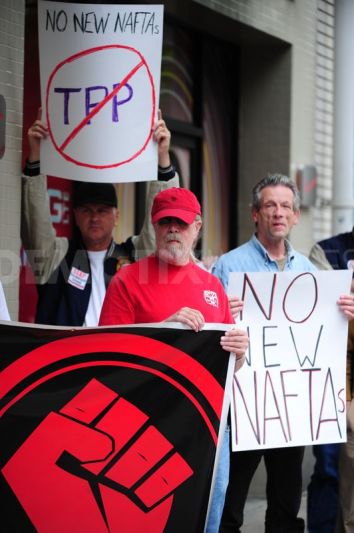
Some officials insist there’s a new dynamic in relations between the two longtime allies. The US and Philippines, Kerry averred, have a “very, very important relationship at this point”. He cited rising tensions over the South China Sea as well as the Philippine’s interest to join the 11-nation Trans Pacific Partnership (TPP).

“We agreed that as strategic partners, it is important for both our nations to further deepen our relations on all levels,” Del Rosario said after their closed-door meeting. “We agreed that our long shared history and profound common values serve as a firm basis for this.”

The US pivot to Asia has put the Philippines, which is widely perceived here as having repaired its reputation for abuse and corruption, in a new light for American policy-makers. Many say irritants have become fewer and the room for cooperation wider.

“I think they like what they see in the Philippines and want to encourage us, and help us to succeed,” one ranking diplomat explained to us.

The Philippines relies on the US security umbrella, including hand-me-down military hardware, to deter an increasingly aggressive China. At the same time, the US will need willing and reliable regional partners to expand its footprint in Asia.

On the table is the “rotation” of US forces to the Philippines, which is rapidly regaining its old role as a major logistics hub for the US military. The US Navy recently signed a contract with an American contractor working out of Subic, Zambales to re-supply and repair its ships. They are reportedly looking at empty warehouses in Cubi Point to pre-position materiel for disaster relief as well as the rapid deployment of state-side forces to Asia if the need arises.  

“Our ability to deter threats or provocation is an important part of cooperation,” Del Rosario declared. “In this context, we discussed our joint efforts to build the capacity of the Philippines to defend its territory and people. We also exchanged views on the implementation of our agreed policy of increased rotational presence and enhanced exercises.”

Also in town was Singapore Prime Minister Lee Hsien Loong, who became the 3rd Asian leader to meet with President Obama in his 2nd term. The visit comes as the US Navy begins deployment of the 1st of four littoral combat ships (LCS) in Singapore next week.

Those futuristic warships, seemingly tailor suited for waters in Southeast Asian archipelagic nations, are expected to sail in Philippines waters when the CARAT naval exercises get underway in a few months.

US Navy ships calling at Subic have noticeably increased; at least four in the last month alone, including the 7th Fleet flagship USS Blue Ridge.

Philippine Navy chief Vice Admiral Jose Luis Alano is expected in DC this week. The 2nd of the Hamilton-class all-weather patrol ships acquired from the US Coast Guard is scheduled to finally sail for Manila after months of training and refurbishing by her Filipino crew in North Carolina.

Also on the table is the Philippine interest to join the Trans Pacific Partnership (TPP) which aims to eliminate tariffs among the 11-nation trading bloc. The US, Australia, Brunei, Canada, Chile, Malaysia, Mexico, New Zealand, Peru, Singapore and Vietnam are currently negotiating a regional free trade agreement. The last round of talks was held in Singapore last month, and the next, the17th round is scheduled in Peru next month.

“The Foreign Secretary and I will talk about the important trade relationship, and particularly the TPP, which we both have interest in. And I look forward to having a very good conversation with him about that,” Kerry said.

Some impediments for the Philippines are its constitutional limits on foreign ownership, backward labor practices and intellectual property rights violations.

The US is reportedly backing the Philippines for TPP membership and at the same time nudging it to adopt reforms, including amending the Constitution and enacting new laws to ensure a “level playing field” for foreign investors and businesses in the country.

An official said they felt a “readiness to help” from their US counterparts on the Philippine’s TPP bid. Whether it’s helping the country stare down a powerful, menacing neighbor or opening the door to an exclusive economic club, there appears to be an unprecedented confluence of interests between the two longtime allies.


Thursday, March 28, 2013

FIL-AMS ON BOTH SIDES OF SAME SEX MARRIAGE DEBATE AS SCOTUS ENDS HEARINGS


Same sex marriage is evidently one of the most divisive issues in America today. It’s drawn a line even for Filipinos here – and perhaps a sign of how deeply fractured they are, is the way Fil-Ams have emerged in the forefront of the debate for both sides.

The Wall Street Journal has noted how the crowds in front of the US Supreme Court, which wrapped up yesterday two days of hearings on California’s Proposition 8 and a challenge against the Defense of Marriage Act (DOMA), appeared larger than last year’s “Obamacare” hearings.

The High Tribunal isn’t expected to render a ruling until July.

The schism can be attributed to how people perceive the issue. Many supporters of same sex marriage see it as a civil rights issue with a primal impact on the guarantees of the US Constitution. Those opposed are convinced it is a moral issue.

Former Solicitor General Theodore Olson, arguing against Proposition 8, told the justices that marriage is a fundamental right of all Americans, regardless of gender.


The Baltimore Sun wrote Wednesday:  “The argument against Proposition 8 and the argument against DOMA both rely on the proposition that laws treating gays differently should be subject to "heightened scrutiny," given the history of discrimination against them and their inability to defend themselves through the political process. (The brief defending DOMA, hilariously argues that gays are in fact among the most politically powerful groups in America, the passage in the last 17 years of three dozen state laws banning gay marriage notwithstanding.)”

Only nine states – including Maryland – as well as the District of Columbia have legalized same sex marriage; 39 other states prohibit it either in their constitutions or by statute.

Interestingly, both cases reached the SCOTUS because incumbents refused to defend what are existing mandates – the California governor viewed Proposition 8 unconstitutional and President Obama ordered last year Attorney General Eric Holder not to support DOMA in the Supreme Court for the same reason.

Lesbian partners Jay Mercado and Shirley Tan have testified on Capitol Hill for same sex rights. They have twin sons and live in Pacifica, California. Mercado is an American citizen but Tan has been threatened with deportation back to the Philippines because she’s not recognized as Mercado’s legal spouse that could have paved the way for acquiring American citizenship.

Pulitzer-winning Filipino journalist Jose Antonio Vargas has tried to draw a parallel between the struggle for same sex rights and the campaign to fix the country’s broken immigration system. For young Fil-Ams, at least in the Metro DC region, those lines intersect frequently under the LGBT movement.

The same can be said of opponents of same sex marriage – where it hits the anti-abortion, pro-life movement. It is small wonder that Fil-Am opposition to same sex marriage is largely fueled by religious and cultural factors.

When the otherwise popular Filipino boxing champion and now-lawmaker Manny Pacquiao weighed in on gay marriage – anchoring his opposition to his interpretation of the Bible – it drew a quick rebuke from a young gay Fil-Am in California.

Though Filipinos are generally welcoming to LGBT couples, that has a limit and often it’s dictated by their understanding of Biblical prohibitions, flavored heavily by the cultural taboos they have carried across the Pacific.

One survey showed nearly 80 percent of respondents in the Philippines believe same sex marriage is “always wrong”. ABS-CBN’s Balitang America ran a poll last night that showed 71 percent of Filipinos saw same sex marriage as a sin.

Those who oppose same sex marriage, viewing the debate from a moral and ethical perspective, have invoked the classic church vs state argument as well.  Balitang America had featured Fr. Domeng Orimaco, a Filipino parish priest in Daly City, California who blamed President Obama for what he sees as an erosion of the institution of marriage.

Still, the political history of the United States has rarely favored the status quo.

Same sex marriage is divisive because it’s so complex and profound, and elicits such powerful emotions. I’ve tried litigating this at home and after a long, draining but inconclusive discussion, I vowed never to do it again. I’ll just wait for the SCOTUS decision.


Saturday, March 23, 2013

ELIMINATING VISA BACKLOG A CHALLENGE FOR IMMIGRATION REFORMS


More than 4 million people have approved petitions for legal permanent residence in the United States but most can’t because their priority dates have not become current.

The Migrant Policy Institute (MPI) has published a brief, the first in a series timed with negotiations on Capitol Hill for a comprehensive immigration reform bill that explains the “line” for people who want to live and work lawfully in the United States.

In Going to the Back of the Line: A Primer on Lines, Visa Categories, and Wait Times they reveal the various ways of winning Legal Permanent Resident (LPR) status and eventually, American citizenship.

The Philippines remained the 4th largest source of immigrants in 2012, according to the latest report from the Department of Homeland Security’s Office of Immigration Statistics.

However, Filipinos comprise the 2nd biggest bloc of immigrants (next only to Mexicans) who acquired US citizenship last year – suggesting the importance they put on becoming Americans as quickly as possible.

The DHS said over a million people were granted legal permanent status in 2012; more than half of them (53 percent) were already in the US when their applications were approved – refugees, temporary workers, students, relatives of US citizens and undocumented immigrants, among others.

The number of new Filipino LPRs grew minimally, from 57,011 in 2011 to 57,327 last year but still fewer than the 58,173 in 2010. Mexico, China and India topped the list.

While immigration was slightly down, naturalizations were up – 757,434 in 2012 compared to 694,193 the previous year. Mexico, the Philippines and India topped this list. The DHS noted a decades-old trend of Asians surpassing Europeans continued in part because more Asian immigrants choose to become American citizens.

This has contributed to building a huge backlog of petitions. The MPI report cited government statistics that showed 723,000 family-based visa petitions and 73,000 employment-based petitions were filed in Fiscal Year 2012.

For 2012, only 370,951 immigrant visas – for both family and employment based petitions – were available under quota limits imposed by Congress (the Immigration Act of 1990 sets an annual limit of between 416,000 and 675,000).

In addition, there are per-country limits equal to 7 percent of the total number of family-sponsored and employment preferences (25,967 per country last year).

“Nationals of countries with especially high levels of demand in certain family-based and employment-based visa categories (currently Mexico, the Philippines, China and India) face longer wait times because fewer visas are issued each year to these countries,” the MPI explained.

For Fil-Ams, the wait times are longest for those petitioning siblings (about 24 years – the longest among all the categories) and adult married children (about 20 years). Employer-based petitions for Filipino workers have a wait time of more than 6 years.

The State Department reported that as of November 2012, there were more than 4.4 million people whose visa petitions (97 percent of them family-based) have been approved but are waiting for the availability of those visas.

Based on current visa ceilings and assuming no new petitions are filed, the MPI estimates it will take the government 19 years to clear this backlog.

The MPI says the visa backlog could even be higher, and it’s uncertain whether some of them may be part of the 11 million estimated undocumented immigrants in the country. “This is a critical point because the impact of any new legalization program on the current backlog will undoubtedly depend on how many unauthorized immigrants are being double-counted,” they said.

The MPI suggested fixing this backlog is crucial to any immigration reform bill that would require undocumented immigrants to “go back the line”.

They added, if Congress and President Obama decide to pursue this path in immigration reforms, they will have to “contemplate adding additional visas in order to be meaningful”.


Thursday, March 21, 2013

U-S TELLS TPP ASPIRANTS – YOU’VE GOT TO SHOW HOW MUCH YOU WANT IT


If you want it, you’ve got to work for it – that seemed to be the challenge hurled by acting United States Trade Representative Demetrios Marantis to the Philippines and other countries that have expressed the desire to join the 11-nation Trans-Pacific Partnership (TPP).

“Whether it’s China, whether it’s the Philippines, whether it’s Thailand, whether it’s Taiwan, it’s incumbent upon those economies to be able to convince the other TPP partners that they are capable of meeting the high standards that we’re negotiating,” he stressed at a press briefing yesterday (March 20) at the Foreign Press Center in Washington DC.

The Philippines’ top envoy in Washington revealed the country’s “road map” to gaining a coveted seat in the TPP which will virtually eliminate tariffs and other trade impediments among the partner nations.

TPP currently has 11 “partner nations” – Brunei, Chile, New Zealand, Singapore, Australia, Peru, the United States, Vietnam, Malaysia, Canada and Mexico. The 16th round of negotiations was held in Singapore last week.

Ambassador Jose L. Cuisia Jr. said the Philippine plan is anchored on three broad pillars of “stakeholder engagement in trade policy-making; trade policy research network and capacity-building; and enhanced interagency cooperation."

Marantis said the Philippines and other aspirants have to “demonstrate a willingness to meet the high standards that we’re negotiating in the TPP agreement."

For the Philippines, that would mean amending the 1987 Constitution to fully open the country to foreign investors, legislating improved labor protection laws and further curbing intellectual property piracy, among others. (Kindly see previous posts)

“One of the key challenges that we face,” Marantis explained, “is ensuring that our exporters and our workers and our manufacturers and our service providers are able to compete on a level playing field."

Although many of President Aquino’s key economic managers and advisers are keen on the TPP, he has been described as “waffling” on the benefits of joining the trade pact which many see as a springboard for larger economic collaboration in the Asia-Pacific region.

“We are not being invited yet. If we get invited, there are certain qualifications that must be done. The process is long,” the President said, referring to key structural and legal reforms needed for joining the TPP.

“The United States and the TPP, our partners don’t invite countries or economies to join – it’s the reverse,” Marantis averred.

“If an economy is interested in meeting the high standards of the TPP agreement, it needs to express that interest; that it’s capable of meeting the high standards that we’re negotiating."

“And the 11 TPP partners then decide by consensus whether or not to admit a new member.  That’s the process that was used with Malaysia when Malaysia decided to join, and that’s the process that was used with Canada and Mexico when they decided they wanted to join last year, and that’s the process that’s underway with Japan,” Marantis explained.


Wednesday, March 20, 2013

HAGEL LIEUTENANT TALKS TO AMERICA'S ASIAN ALLIES


A top Pentagon official discussed with Philippine leaders the mechanics of deploying more American troops in the country as part of the United States “rebalance” in Asia.

US Deputy Defense Secretary Ashton Carter was the most senior member of newly appointed Defense Secretary Chuck Hagel’s team to visit Manila this year. The Philippines was part of an Asian swing that also took him to treaty allies Japan and South Korea, and Indonesia.

He harped on the US-Philippine security alliance, reiterating the Obama administration’s commitment to help the Philippine military modernize its outdated weapons.

In talks with Foreign Affairs Secretary Albert del Rosario and Defense Secretary Voltaire Gazmin, he addressed concerns about the “sequester” that cuts into the Pentagon budget; the “rotation” of additional American forces under an expanded schedule of “Balikatan” joint training exercises; the emerging “security architecture” in Southeast Asia, especially amid growing fears of Chinese aggression in the South China Sea; as well as continuing cooperation in the war against Islamic terror groups, among others.

The Aquino administration earlier welcomed the deployment of additional US troops in the Philippines, notwithstanding protests from the Left. The Philippines and US have both a mutual defense pact and a Visiting Forces Agreement (VFA) that govern the operations and conduct of US forces in the country.

The US has provided the Philippine Navy with two all-weather patrol ships, with a third being negotiated, that has vastly expanded its footprint in the South China Sea. It’s also financed the construction of an electronic Coast Watch system – a string of radars and sensors in southern Mindanao – that’s slowly being expanded to also look west towards the South China Sea. 

At the same time, the Philippines is seeking fighter jets, maritime patrol planes and fast attack boats from the US and other possible suppliers.

“We had a good discussion on intensifying our defense cooperation and the current challenges in the region,” Del Rosario said. “Dr. Carter reiterated the commitment of the US to work with us and support our efforts to strengthen our military and its ability to defend our country.”

He added, “This increased rotational presence will be crucial in allowing us to maximize our own investment in our defense.”

In Japan, Carter met with top defense officials to discuss the expansion of the US missile defense system, in the face of increasing threats from North Korea, but also that nation’s own headaches with China over a territorial dispute in the East China Sea and the re-location of the US Marines base in Futenma, Okinawa.

That move is widely reported to affect US plans to deploy forces in the Philippines, as the Marines are being asked to occupy a smaller, more isolated area of the island. According to some accounts, most assets will be pulled back to Guam but some may be re-positioned to Australia and the Philippines.

The US and Australia agreed in 2011 for the posting of up to 2,500 US Marines in Darwin. For the Philippines, they will rely heavily on their former naval base at Subic Bay, Zambales where a subsidiary of American shipbuilder Huntington Ingalls Industries recently bought into South Korea’s Hanjin Heavy Industries (Philippines) to provide maintenance, repair and logistics services to the US Navy.

The website thediplomat.com said the US also plans to forward-deploy supplies for disaster relief and humanitarian assistance at the Subic Bay International Airport at Cubi Point, Zambales.

That appears to be acknowledgement of the Philippine’s strategic value – demonstrating it has something that another US logistic hub in the region (Singapore) does not – a world-class port with lot of available space.

Carter, who revealed he had great affection for President Aquino’s father – the martyred Sen. Benigno Aquino Jr. – describing him a “greatadvisor and mentor to students” at the MIT in Boston when  he was studying there, stressed that America had “deep and abiding security roots” in the Philippines.

The US and Philippines have had several recent senior-level engagements, including meetings between Presidents Obama and Aquino, and a historic “two-plus-two” meeting in Washington, DC last April.

“All of that has facilitated real progress across an array of issues not just on defense but on foreign policy,” Carter explained, “our main goal is to keep the momentum going.”

Tuesday, March 19, 2013

CUISIA BARES 'ROAD MAP' TO PACIFIC TRADE PACT BUT IS PH READY?


The Philippines wants to join the Trans-Pacific Partnership (TPP) but some experts warn the window for enacting reforms that would qualify the country in this elite club could be fast closing.

Ambassador Jose L. Cuisia, Jr. outlined a “roadmap” for joining the TPP during a panel discussion at the 2013 Annual Conference on Trade Policy and International Marketing organized by Georgetown University and the American Marketing Association in Washington DC last week.

 
TPP currently has 11 “partner nations” – Brunei, Chile, New Zealand, Singapore, Australia, Peru, the United States, Vietnam, Malaysia, Canada and Mexico. The 16th round of negotiations was held in Singapore last week.

To join them, the Philippines will have to be invited – but it has to meet certain requisites.

The Philippine plan, Cuisia explained, is anchored on three broad pillars of “stakeholder engagement in trade policy-making; trade policy research network and capacity-building; and enhanced interagency cooperation.”

He said this showed the Philippine’s “interest in joining after it had undertaken adequate preparations for the commitments required under the agreement.” Those “preparations” appear to be the proverbial elephant in the room at least where the Philippines is concerned.

Most experts say it will involve amending the 1987 Constitution, tearing down some of the most restrictive foreign investment rules in Asia, and aligning the Labor Code with International Labor Organization (ILO) standards on the rights of workers, an early staple of TPP agreements.

Not only is there a wide gap between what is and what should be, the process revives old fears about opening the Charter to changes. It’s apparently been deemed so risky that at least two past administrations (indications are there will be a third) opted to kick the can down the road despite earlier acknowledging the need for the amendments.

The five ILO principles are freedom of association; the elimination of all forms of compulsory or forced labor; recognition of the right to collective bargaining; abolition of child labor; and the elimination of discrimination in employment and occupations -- the last three said to be “problem areas” for the Philippines according to some.  

The Philippine remains in a US watch list of Intellectual Property Rights (IPR) violators. The US Trade Representative said they are “encouraged” by the decline in movie piracy and remain hopeful about “improving the quality of criminal investigations and prosecutions.” They also urged the government to open the market for US-made pharmaceuticals.

 
And assuming a TPP agreement is forged, will they be accepted by Filipinos?

Three years ago, Assistant US Trade Representative Barbara Weisel said in Manila that the Aquino administration would likely need to build “domestic consensus” to achieve all these.

With a move fraught with political peril, why pursue TPP at all?

For one, the Philippine’s long-term viability apparently depends on it. The Department of Trade & Industry in Manila estimates a TPP pact could be worth as much $10 billion in additional export revenues. Cuisia said the proposed free trade area would eventually account for 40 percent of global Gross Domestic Product (GDP).

“Aside from trade in goods and services, (TPP) also covers foreign investment, government procurement, intellectual property rights and environmental and labor protections,” Cuisia argued, pointing to the wide-ranging effects of joining the pact.

He stressed the Philippines simply can’t afford not to be part of it, along with the ASEAN-led Regional Comprehensive Economic Partnership (RCEP) with dialogue partners Australia, China, Japan, South Korea, India and New Zealand that aims to remove 95 percent of tariffs on goods.

Japanese Prime Minister Shinzo Abe announced this week their intentions to join TPP negotiations, raising the prospect that the Philippine’s top two trading partners and sources of foreign investment – the US and Japan – would fall under one convenient yet critical umbrella.

It’s uncertain whether the Philippines can craft a garments trade agreement with the US – the SAVE Act – under the prevailing climate in Washington, when the concessional terms it seeks from an increasingly deficit-conscious US Congress can also be availed under TPP.

TPP is envisioned to eventually become the Free Trade Agreement of the Asia-Pacific (FTAAP).

“The risk of not joining the TPP is that the Philippines might very well find itself competitively shut out of key markets come 2015, particularly in North and South America and perhaps even in our own ASEAN backyard,” business columnist Ben Kritz warned in the Manila Times.

It is perhaps remarkable that Vietnam, one of the late additions to ASEAN, was able to tap early into the TPP (it began negotiations in Nov. 2010) and push structural, legal and market reforms at a pace that’s brought them closer to an agreement, possibly by this year.

One difference appears to be President Aquino. Although he’s given the green light to pursue the TPP, press reports as late as last January suggested he still wasn’t sold on the TPP. 

“Before we do it (charter change), let us have concrete evidence first that this will be helpful to our nation,” according to the Philippine Star. He noted that the TPP’s partner nations were still reviewing their agreements and signalled he was in no hurry.

“We are not being invited yet. If we get invited, there are certain qualifications that must be done. The process is long,” he averred.

“The longer the government waffles on making comprehensive reforms in critical areas—which most would say it ought to be doing anyway, TPP or no TPP—the less likely it will be able to participate,” Kritz wrote in his column.


Monday, March 18, 2013

RETIRED BUT NOT TIRED, HAIRSTONs FOCUS ON EDUCATION


Is there life after retirement? I read somewhere that Ernie and Mencie Hairston retired recently but why do they look busier now than when they were, well, working.

They recently opened five scholarships for high school graduates under the High Bridge Foundation, Inc., a Bowie, Md.-based non-profit which they formed last year. The scholarship, Mencie explained, would help pay the cost of attending a trade school, community college or university of the beneficiary’s choice.

Graduating high school students in DC; Prince George’s and Montgomery counties in Maryland; and Arlington and Fairfax counties and Alexandria City in Virginia who are in dire need of financial help to pursue a college diploma are eligible to apply for the scholarship.

The deadline for submission of applications is April 19. You can access forms here.

A veritable dynamo, Mencie has been part of virtually all of the big Fil-Am organizations in the Metro DC region. Many of them she helped start, from charities to congressional lobbies for pushing the diverse Fil-Am agenda in the nation’s capital.


She’s still involved with Mabuhay Inc., another non-profit, which helps both Filipinos and Americans bridge the cultural divide through lessons usually given in summer in Greenbelt, Md. The unique school draws Americans who had married or are about to marry Filipinos, couples raising bi-racial children or those adopting children from the Philippines, and 2nd generation Fil-Ams who want to know more about the “old country”.

Ernie and Mencie have shared a passion (aside of course from their “apo’s”). Cognizant that she’d be an enthusiastic voice in and outside the Fil-Am community, we asked Mencie during last year’s political campaign “what would draw her to support a candidate”?  She shot back almost instantaneously – “education…anyone who’ll give our kids a good education”.

She tried to get me to join a 5K walkathon (I never made it but I was told over 150 did) to raise money for scholarships in the University of Maryland’s Asian American Studies program. It offers financial aid for deserving students who want to specialize in this field, including two scholarships given in honor of outstanding Fil-Ams – labor leader and civil rights activist Philip Vera Cruz and retired US Army Maj. Gen. Antonio Taguba.

Mencie is part of the AAST scholarship committee.

“We want to ensure that these scholarships are always there for everybody. That’s how we learn about each other,” she averred.

The High Bridge website explains that, “Dr. and Mrs. Hairston are life-long supporters of youth programs that address the needs of young people, especially those with disabilities and life challenges, who may not have easy access to scholarship information and funding.  

“As recipients of scholarships during their student days, Dr. and Mrs. Hairston are aware that a scholarship is more than just free money -- it is a donor’s financial investment in a student’s potential to succeed and to give back to the community as well.”


Saturday, March 16, 2013

FIL-AM TEEN PACKS BIG VOICE IN SMALL PACKAGE


She didn’t look nervous at all. Not even when diminutive Kriskatlin Zabala walked to the middle of the Verizon Center basketball court and over 18,000 pairs of eyes and ears tuned to her rendition of the “Star Spangled Banner”.

It was “Filipino Heritage Night” at the Verizon where a packed house came to see the Washington Wizards and New York Knicks play. Kris was asked to start the evening’s main event by singing the national anthem. It was a far cry from the Fil-Am gatherings where she’d be tugged by her parents to sing some familiar ditties. This was her biggest audience and she winged it like a pro.

The 13-year-old student from Fred Lynn Middle School in Woodbridge, Va. has been singing even before she started talking. “Even before I started saying words, I could already sing,” she revealed.

“I couldn’t recognize the words or how to pronounce them but I learned the tone and the way they were sang,” Kriskatlin said matter-of-factly.

She’s the youngest daughter of Alfredo Zabala of Bataan and Catalina Zabala of Manila, both active members of the Fil-Am group Kababayan Inc.

Her parents’ involvement in the Filipino community of Northern Virginia is actually what got her started. She admitted they’ve encouraged her to sing. “They want me to take vocal lessons,” she revealed, “They want me to show my talent to all their friends.”

Not that she minds. She says the whole family is fond of singing, egged on by their father who actually introduced her to the rudiments of voice and melody. Alas, Kriskatlin intimated, his father is “hiya” (shy) so his dreams of singing publicly lives on in his daughter. 

Her elder brothers and sisters are either in college or working so that left her to carry the family’s musical ambitions. “Since everyone else is busy and they’re old (her eldest brother is 30 but she has a 10-year-old nephew who she says “I can still boss around”) I’m the only one who can do the stuff,” she explained.

“The stuff” is for the moment limited to entertaining her parents and their friends, something she does because she can, but is still unsure whether that’s the path she wants to follow. “I’m not sure it’s something I want to pursue later on. It depends on what I want,” she averred.

She hasn’t decided whether to audition for “American Idol” because that’s two more years down the road due to contest’s age requirement.

Kriskatlin is only starting to explore teen-hood but her talent is opening a whole world of opportunities for her.

Friday, March 15, 2013

FRANCIS: A POPE FOR THE TIMES


Every election of a new Pope augurs a fresh beginning for the 1.2 billion-strong Roman Catholic Church.

Pope Francis is being closely scrutinized. The Faithful hang on his every word, every gesture to imagine the contours and colors of his papacy. From most accounts, Pope Francis has brought hope to a church rocked by scandal and facing huge challenges.

I can imagine friends like lawyer Arnedo Varela ecstatic over the rise of a Jesuit Pope. Or my daughter who was educated by Franciscan nuns.  My brother had joked in a Facebook post that only the Dominicans weren’t in a celebratory mood (well, we brothers all did go to the University of Sto. Tomas for college so I guess we can joke about it).

Over the past days, I feel like I’ve pored over nearly every news report about Pope Francis. I was enthralled by accounts of his simplicity and humility, and his affection for the poor and the disenfranchised (I was especially struck reading how as archbishop of Buenos Aires he chastised priests who refused to baptize the children of unwed mothers).

It brought back my own experiences, growing up with the Salesians of Don Bosco who probably exerted the greatest spiritual impact on me.  The Salesian order was established in the pits of the “industrial revolution” to help educate the sons of a growing army of unemployed, displaced and impoverished by the machines that were supposed to bring progress.

Many of the Salesian priests (at least during my years there) were Italians. They taught us how to play soccer until they succumbed to the Filipino addiction to basketball. They introduced us to those quixotic concepts of “free will” and “conscience”. We heard Mass three times a week (excluding the feast days), encouraged to avail of the Sacraments (one elderly priest who’d probably heard his share of confessions from young punks had come up with a list of sins so all we had to do was answer yes or no, then say our penance) and make ourselves always busy (one favorite motto – “an idle mind is a devil’s workshop) either through study or sports.

When I think of the Pope, I think of the church and when I do, I think of personal values – mine as well as those around me. Then I go back to what the Salesians taught me. For more than a decade and through some of my formative years, I saw them as the face of the Church.

The Church is facing difficult times. The sex abuse scandals, debate over contraception and gay marriage, allegations of financial mismanagement, growing secularism and radicalism within the church, and host of other troubles will have to be addressed by Pope Francis.

If his actions are any indication, Pope Francis intends to take the Church back to its “core competency” which is saving souls through the practice of simplicity, humility and above all, hope. He also talked about evangelization.

When Manila Archbishop Luis “Chito” Cardinal Tagle (who also happens to be Jesuit) visited Washington DC last year, he talked about the role of Filipinos in spreading Christ’s Gospel. He said the over 10 million Filipinos who now live and work in all corners of the globe are especially well-positioned to help spread “Filipino-style Catholicism” in their adopted communities.

While the Church can dictate dogma, for most of the Catholics I know, it is a deeply personal affair steeped in family and tradition that I believe are the hallmarks of “Filipino-style Catholicism”.

In Don Bosco, the priests imbibed a practice that I still carry on to this day; something that I can attest has never failed me. In the darkest days or the brightest, after tragedy or unexpected bounty or as an act of contrition, one “Our Father”, three “Hail Mary’s” and a “Glory Be” said alone, with a sincere heart for the Virgin Mary’s intercession convey our petitions to the Almighty.

If there was anything I learned from the Salesian fathers, it is the power of prayer and God’s love.

There, I believe, lies the church’s future. To teach the coming generations just as the Salesians had taught me. Life is simply too tough and complicated without the spiritual tools to steer us through. Through good works and better still, good example. I pray for Pope Francis because he bears the heavy burden of shepherding the church to a brighter future; because without it, I doubt we’d have one ourselves. 

Tuesday, March 12, 2013

FIL-AM SERGEANT COOKS MEALS FOR U-S DEFENSE CHIEF


If Defense US Secretary Chuck Hagel develops a fondness for chicken relleno or pinakbet blame it on one very talented Filipino-American chef.

Staff Sgt. Ghil Medina has been with the US Air Force for the past six years. He is officially part of the 633rd Force Support Squadron working out of Langley Air Base in Virginia. But he is also one of the cooks who feed the Defense Secretary and other Pentagon brass and is sort of a celebrity within the elite clique of culinary warriors.

He’s already collected a silver medal in the K1 “professional” category of the 38th Military Culinary Arts Competition at Fort Lee, Va. which ends on Friday (March 15). Medina won on a dish that he says was inspired by his Filipino roots – chicken relleno, mixed vegetables and garlic rice with adobo sauce.

Hagel is probably no stranger to Asian dishes. He served and was wounded twice in Vietnam in 1967-68 as a squad leader with the 9th Infantry Division. But unlike that other Vietnam War vet in the Obama Cabinet (State Secretary John Kerry) I couldn’t find any record that Hagel stopped at either Subic or Clark where the seriously wounded were usually brought from Vietnam to recuperate.

But the 25-year-old Medina assures he’ll be well fed in the Pentagon.  The Secretary, he revealed, “eats simple and on the healthy side”.

Medina’s life story is like that of many other immigrants to the US. He survived on “bare essentials”, living with his godparents until his father and stepmother could bring him to New York when he was 18 years old.

“It’s a different world,” he told a US military journal years back. “In the Philippines, if you don’t have anything, you truly don’t have anything. I know the definition of starvation.”

He joined the USAF to get a college education. His family couldn’t afford the tuition and financial aid was out of reach, he explained. He enlisted in 2007 and rose steadily through the ranks by topping one exam after another and reaping awards. He also started winning cooking competitions in the military.

"I put so many hours in the kitchen, it was exhausting. But I knew I had to work that hard to get where I wanted to go," Medina declared. "I wanted my whole life to be a success and make a better life for myself, and this was how I was going to do it."

He is competing with the “best of the best” in the US Armed Forces. For those who’ve been in Clark and Subic when the Americans still ran the bases, it’s obvious they fed their soldiers well.  At Fort Lee, they had well-stocked containerized kitchens that were probably the closest thing they could come up with to simulate field conditions. 

"What they can expect here is enhanced professionalism, enhanced culinary skills, more developed techniques in the arts of food preparation and food sanitation, and the credentials that will allow them to be recognized in the private industry," explained Lt. Col. Luis A. Rodriguez, director of the Joint Culinary Center of Excellence at Fort Lee in a US Army website.

Medina said he doesn’t mind going back to Lackland Air Base in San Antonio, Texas where he started, and cook for other Airmen. “I am passionate about cooking because I love to make people happy. That's the main thing,” he stressed.

Monday, March 11, 2013

AN EVENING IN THE MOVIES


There were exactly 11 of us in a theater that could probably sit 200. It wasn’t exactly a “drove” but considering that the AMC theaters at the Hoffman Center in Alexandria, Va. wasn’t in the press release or included in the advertisements, I thought “A Moment in Time” drew a decent-sized crowd.

My daughter discovered the movie – featuring perhaps the Philippine’s hottest “love team” of Coco Martin and Julia Montes – by sheer accident. She was actually looking for the nearest IMax that was showing “Oz” and found one at the Hoffman Center, about a block or two from where we worked.

It was a bit surprising to see a Filipino movie (with English sub-titles) running in that part of Northern Virginia. They were usually shown at the Lohman theater along Arlington Blvd., which wasn’t really any better proximity-wise for Filipino movie-goers scattered all over this region (in the press releases for the movie, it only listed another AMC theater in Gaithersburg, Md.)

It did however offer some modicum of habit as people got used to going there to watch Filipino movies.

We’ve heard occasional griping here about Filipino entertainers neglecting this region. The big-name stars from home usually trek to New Jersey in the north or Virginia Beach to south, where the Filipino market is more compact.

Metro DC may not yet attained the “critical mass” to convince promoters to make the region a standard stop for Filipino entertainers, but it can be a key demographic for those peddling Filipino wares in search of bucks as well prestige.

Last year, the Philippine Embassy brought the world-renown Bayanihan dance troupe to the Kennedy Center, that magnificent edifice by the Potomac River that’s become a center of the arts and culture (they also performed in New York).

They also helped promote in Silver Spring, Md. celebrated Fil-Am filmmaker Ramon Diaz’s latest work about the rise of Journey front man Arnel  Pineda from obscurity to YouTube sensation to being part of one of America’s most successful rock bands. The documentary began its regular theatrical run on March 8.

In the Fall, a group led by businesswoman Loida Nicolas Lewis will be bringing “Noli Me Tangere: The Opera” based on Jose Rizal’s satirical novel that helped spark a revolution and pave the way for Asia’s first republic.

There is a sense among Filipinos here to show off who we are. When Menchu Sanchez, the nurse from New York, was invited to attend President Obama’s State of the Union address on Capitol Hill, she wanted to wear her terno until White House handlers asked her to opt for something simpler.

My wife gave “A Moment in Time” two thumbs-up and the others also seemed animated as the credits started rolling. The backdrop was spectacular, I thought Gabby Concepcion looked comfortable playing “daddy roles”, Cherie Gil still looks hot and the movie reaffirms my belief (built over weeks of following the tele-nobela “Walang Hanggan”) that no one weeps (or smiles) as profusely or as adroitly as Coco and Julia.

Still, I wished they had shown some other Filipino movie. Or some more of them. 


Tuesday, March 5, 2013

FIL-AM NURSES TELL PH LAWMAKERS: CLOSE SUB-STANDARD SCHOOLS


It at least took some of the bite from “Desperate Housewives” or racial comments from DC’s former mayor. They can almost be excused because of their ignorance about Filipino medical professionals, but coming from a well-heeled “kababayan”, a “distinguished” member of Congress and the wife of someone who aspired to be Philippine president – the words got to hurt.

Cynthia Villar stirred a hornet’s nest. Her “they don’t need to be that good” comment about Filipino nurses – one of the Philippine’s top exports that generate tens of millions in yearly remittances – has drawn the indignation of Filipino nurses groups all over the world. Yes, they are virtually everywhere.

“Her ignorance is an embarrassment,” said lawyer Arnedo Valera, a co-executive director of the Virginia-based Migrant Heritage Commission (MHC).

Villar is running for a seat in the Philippine Senate this May, and most likely wished she didn’t leave home to sit in that candidate’s forum (she’s running for the Senate this May) and answer questions from Winnie Monsod.


In trying to defend her decision to block the closure of sub-standard nursing schools in 2005, Villar – a name synonymous with Philippine real estate – dug a much deeper hole.  In the first place, how could you possibly justify mediocrity? Apparently, Villar believed, by leveling (or perhaps more accurately, lowering) the playing field. 

“Ang sinasabi naming sa kanila na ‘actually hindi naman kailangan ng nurse na matapos ang BSN. Kasi itong mga nurses, gusto lang nilang maging room nurse,” Villar said.

But the thing is Filipino nurses are flourishing. Countries from the United States to Great Britain to Libya have sought them.

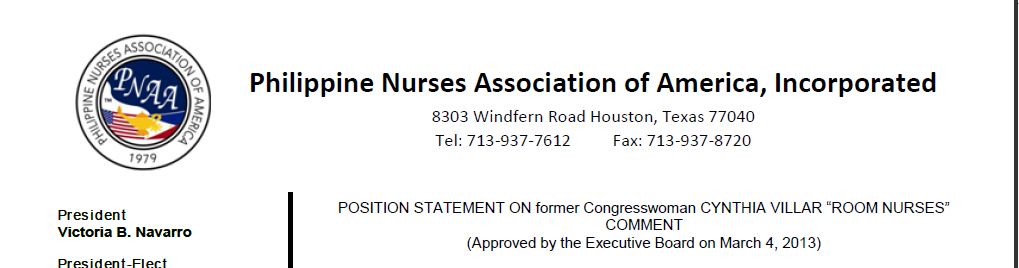
Victoria Navarro, president of the Philippine Nurses Association of America (PNAA) – one of the most influential Fil-Am organizations in the US – attributed this to the “bachelor’s degree preparation of nurses in the Philippines that is at least 4 decades ahead of developed and industrialized nations.”

They are decrying attempts to lower those standards. “The quality and caliber of Philippine schools of nursing must be of the same standard, if not better, with our international peers,” the Texas-based PNAA declared in a position paper distributed today.

At his 1st State of the Union address after being re-elected, President Obama honored Fil-Am nurse Menchu de Luna Sanchez of New York University’s Langone Medical Center who orchestrated the evacuation of 20 at-risk infants at the peak of Hurricane Sandy that devastated New York and New Jersey.

Sanchez, in a Facebook post, said her fellow Filipino nurses were “hurt” and appeared to question Villar’s qualification to run for Congress (“yung mga ganung tao hindi natin nilalagay sa puwesto”).

"While everybody is admiring the professionalism and dedication of our nurses in the US, Ms. Villar is degrading them,” Valera said.

In 2005, more than half of the 21,500 foreign trained nurses who passed US nursing licensure examinations were educated in the Philippines.

Villar has offered her “heartfelt apology” to the Philippine Nurses Association. She argued in a separate interview with Maria Ressa that the 60 seconds to answer Monsod’s question was insufficient.

But this 2nd encounter with the media for the “PHVote” campaign appeared to turn just as badly for Villar who had trouble explaining to Ressa why she seemed to put the “concerns of the business people” above the public.

Here again it seems is the disconnect between rich, successful business people aspiring to be politicians and the people (the 47 percent?) they vow to serve.

“Elected officials in the Philippines must introduce and support legislation that will promote the high quality of nursing schools regardless of business and political pressures and to keep sub-standard nursing schools closed,” Navarro stressed.

Sadly, even at home, Filipino nurses are under-appreciated. Perhaps that’s why they need to prove themselves abroad.