Monday, May 20, 2013

PH ENVOY BLASTS CHINA ANEW ON SEA SPAT BUT IS MUM ON TAIWAN


The country’s top envoy in Washington DC appeared to shift the focus of maritime spats with neighbors from the Philippine’s northern frontier back to the west where a large Chinese fishing fleet was headed to the disputed Spratly islands.

“Over the past two years, the whole world has seen the increase in belligerent activity in the waters in our part of the world, particularly in the areas in and around the West Philippine Sea,” Ambassador Jose L. Cuisia told the annual meeting of the World Affairs Council of Greater Hampton Roads last Friday.

His press release over the weekend made no mention of the more immediate conflict with Taiwan which has stopped hiring Filipino workers, cut trade ties and carried out a much-publicized saber-rattling naval exercise after the Philippine Coast Guard killed a Taiwanese fishermen in waters they both claim as part of their territory.

“When another country stations its boats on a shoal that is a mere 120 miles from our mainland and more than 400 miles from theirs, the Philippine cannot just keep quiet,” he stressed. Adding to his China tirade, Cuisia said “When another country declares that it owns about 75 percent of what the Philippines owns as exclusive economic zone, we are duty bound to stand up and protect it.”


The BRP Ramon Alcaraz begins sea trials off the Carolina coast before making the long voyage home next month.


The part of the Balintang Channel where the shooting of the Taiwanese fishing boat occurred is claimed by both the Philippines and Taiwan as part of their exclusive economic zones. Efforts to define that maritime border and possibly craft a joint use agreement have been stymied by the Manila’s “one China policy” where it only recognizes the government in Beijing. 

The United States has expressed concern over the May 9 flare-up and called on both sides to lower the tension. The Philippines and Taiwan are longstanding American allies, crucial to its long-term designs to reign in China and ensure freedom of navigation in the South China Sea through which, Cuisia pointed out, $1.3 trillion-worth of US products flow through yearly.

Some officials here say the Philippines is eager to put the crisis with Taiwan behind them and focus on the South China Sea where China has actually, and in some instances, virtually occupied Philippine territory. They have built permanent structures on Mischief Reef just 130 miles off Palawan and last year, cordoned off Scarborough Shoal which lies 120 miles off Zambales in the main Luzon Island.

Two Chinese spy ships have reportedly dropped anchor last week about 6 miles west off the Philippine-occupied Ayungin Shoal, near Mischief Reef.

The Philippines has hauled China to a United Nations tribunal on the laws of the sea to have the latter’s claim, the so-called 9-dash-9, declared as invalid. China alleges that ancient maps assigned her ownership over virtually the entire South China Sea.

The Philippines has sought and received military assistance from the US, a treaty ally with which it has a mutual defence pact. “We are look at opportunities for assistance in training, capacity building and humanitarian assistance and disaster relief,” Cuisia averred.

As part of President Obama’s pivot to Asia, the US is stepping up its military presence in the region, including more frequent US Navy visits to the Philippines. Although Cuisia emphasized the American “rebalance” in Asia also entailed intensified economic and trade ties, there is no mistaking the security bias towards containing a militarily resurgent China and shielding America’s allies against her growing belligerence.

As if to emphasize that dimension of PH-US relations, Cuisia visited the USS Wasp, the Norfolk-based amphibious assault ship which is being prepared to accommodate the US Marines variant of the F-35 Joint Strike Aircraft. He was able to speak with the ship’s Filipino-American crew members during the brief visit.


Monday, May 13, 2013

PHILIPPINE ARMY’S ‘WANTED GENERAL’ GETS LEGION OF HONOR, HANGS THE UNIFORM


Who would think that the general, who once had an “arrest warrant” put out by communist insurgents, could also be a “sorbetes magnate” who last week was given one of the highest decorations a grateful country can give as he closed here in Washington DC a storied military career?

Maj. Gen. Cesar Badong Yano was the country’s defense attaché since 2011 and is credited with working with the Pentagon for the procurement and delivery of two badly-needed high-endurance patrol ships for the Philippine Navy as the Philippine military shifted focus on external defense and the country’s vast maritime borders.

He officially ended that stint and retired from military service – after 34 years, 4 months and 9 days – on his birthday last May 10.

The citation for the Philippine Legion of Honor Award extolled his “eminently meritorious and valuable services” enhancing diplomatic and security relations with the United States as well as Canada.

The citation said Yano provided the Department of National Defense and Armed Forces of the Philippines “vital information that served as basis in the decision making of government policy makers…relentlessly engaged Washington DC-based security experts and think-tanks to discuss security implications to the Philippines and the Asia-Pacific region and submitted numerous reports very relevant to the present security dynamics in the regional and global arena…”

Under his watch, the Philippine Navy procured two Hamilton-class weather high-endurance cutters (WHECs) that were re-christened the BRP Gregorio del Pilar (currently the PN flagship) and BRP Ramon Alcaraz. A Philippine Air Force C-130 “Hercules” cargo plane was also successfully overhauled in Mojave, Ca. and the AFP itself got $2.8 million-worth of new weapons and various military supplies.


But Yano already had a distinguished career even before he arrived in Washington DC. A native of Sindangan, Zamboanga del Norte, he received his commission from the Philippine Military Academy in 1980.

He is the flipside of a deeply respected tandem in the Philippine Army – his elder brother Alexander (PMA Class ‘76) was a former Chief of Staff of the Philippine Armed Forces (2008-09). When we first interviewed him after taking over the Washington DC post, the younger Yano said he decided to join the military so he could watch his brother’s back. And in a Facebook post of his awarding and retirement ceremonies at the Philippine Embassy last week, his “Kuya” was among the first to greet him, welcoming him to the “retired ranks”. It would appear the siblings still keep an eye out for each other.

The younger Yano cut his proverbial teeth leading a reconnaissance platoon with the 1st Infantry “Tabak” Division in Sulu.

He was a team leader at the Presidential Security Command – which strongman Ferdinand Marcos transformed into his Praetorian Guards – during the People Power uprising that eventually led to his ouster and midnight-hour escape to Hawaii in 1986. Though the popular revolt was relatively peaceful, it severely tested the Filipino soldiers’ professionalism and patriotism; Yano stressed that to this day, he is proud he never disobeyed orders yet upheld civilian supremacy and democracy.

He led an army intelligence team in Southern Luzon, served as assistant chief of staff for civil military operations and spokesman for the 4th Infantry Division in Northern Mindanao. He got his first command, the 29th Infantry Battalion, in 1999.

His field assignments were book-ended by a detail as military aide to then Senate President Ernesto Maceda in 1997 and headquarters duties at General Headquarters in Camp Aguinaldo and the Philippine Army headquarters in Fort Bonifacio from 2000 to 2004 and later as the military’s chief liaison with Congress in 2010.

By 2005, Yano was back in the field, serving as chief of staff of the 7th Infantry Division and later the Northern Luzon Command, both based at Fort Magsaysay in Cabanatuan City.

Two years later he was given command of the 302nd Brigade which had combat battalions operating in the islands of Cebu, Bohol and eastern half of Negros, and appeared to have done such a good job against the New People’s Army (NPA) that they issued a “warrant of arrest” against him and six other army field commanders.

And as he swaps dress suit and combat fatigues with more lively civilian attire, another facet of the man has emerged. It turns out he’s also a “sorbetes magnate” of sorts – he owns a large fleet of ice cream carts – those innocuous, colorful, street-bound push carts that are as much as part of most Filipinos’ childhood as bubblegum or “patintero”.

Nothing perhaps conjures up happy childhood memories faster than “dirty ice cream”, slowly dripping down a sugar cone under the summer sun. They’re refreshing and cheap, but the income Yano made from his “sorbetes” carts helped send his children to Ateneo and LaSalle which he couldn’t have afforded on an honest general’s pay.

If there were qualities that I thought would explain his life’s many successes, it would be his sincerity, humility and keen eye for opportunities. The first piece I posted about him on the internet in 2011 received so many hits I was sure he had a fan’s club back home. I realized then Cesar Yano leaves lasting friendships because he never gets tired of creating new ones and this has made him a “wanted man” wherever he goes and in whatever endeavor he decides to do.


Tuesday, April 30, 2013

MAIDEN FIESTA DRAWS OUT FIL-AMS OF CENTRAL VIRGINIA


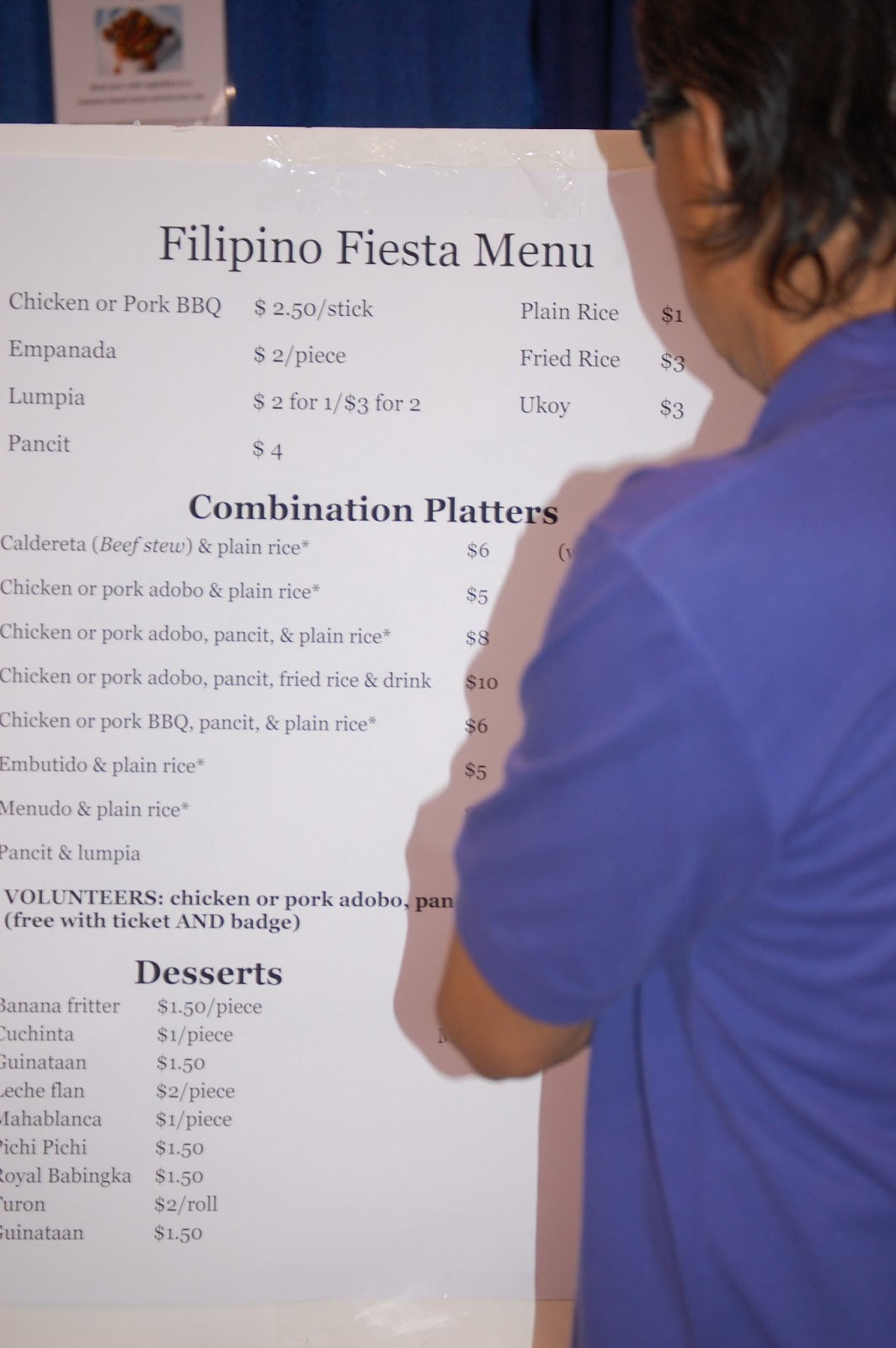
The nascent Filipino community in the Virginia heartland celebrated a coming-out-party of sorts when it organized their first fiesta at the Richmond Convention Center last Saturday (April 27).

“We don’t know how big we are,” said Rudy Bolipata, a long-time Richmond resident. “But when we have gatherings, we notice there are always a lot of new faces.” He said community leaders cooked up the Filipino Fiesta not only to showcase the Filipino’s rich cultural heritage but also partly to gauge just how large they are. And from the fiesta’s smashing success, they obviously were large enough.

The last Census suggests there are fewer than a thousand Filipinos in Richmond, the seat of the Commonwealth of Virginia, and its adjacent counties. About an hour-and-a-half’s drive from Washington DC, this old and historic city lies between the large, rapidly-growing Filipino-American communities in the national capital region and the Tidewater region which includes NorfolkVirginia Beach and Newport News, among others.


“Dati isang association lang kami,” Bolipata explained, “ngayon mayrun na ibang lumulutang.”

From parishes and neighborhoods, Filipinos are slowly showing their collective clout. Perhaps evidence of this was last weekend’s Filipino Fiesta that was attended by Fil-Am Congressman Bobby Scott (3rd Dist., Va.) and former Virginia Attorney General Ken Cuccinelli and former Democratic Party chairman Terry McAuliffe who will be battling for the Governor’s post in November (Cuccinelli dropped by in the morning and McAuliffe arrived shortly after his Republican rival left, according to Bolipata).

Some might be surprised that there’s been a Filipino American Association of Central Virginia (FAACV) since 1972. Romy Hernandez, another longtime Richmond resident, said one of the most active Filipino organizations here is from the Our Lady of Lourdes parish which will be holding its 8th annual Filipino festival this August.

One of those parishioners is University of the Philippines-trained educator Eddie Ilarde who volunteers to teach folk dances to 2nd generation Fil-Ams here. A math teacher by profession, he says he’s just one of about 200 Filipino teachers in Richmond and nearby Chesterfield, Petersburg and Hanover.

“You bring whatever you have and you share it,” he explained of the Kultura Pilipino, a Fil-Am cultural ensemble that includes both young Fil-Ams and their non-Filipino friends who’ve been enamored by the regal “Singkil” or the lively “Maglalatik”.

“Mga ka-klase ng mga anak namin,” Ilarde explained of their recruits, “Kapag nakikita kami mag-practice they want to join because the dances are very challenging and we encourage them to come.”

There are others helping him with the teaching, Ilarde says, some former members of the world-renown Mabuhay and Bayanihan troupes who’ve settled in the region. 

“We have a relatively young community,” Bolipata averred. “We have (Filipino) teachers, nurses and IT professionals who work for companies here. We have doctors – there are 14 of them in Petersburg. Maraming lumilitaw because of mixed marriages – you can see them now but not before.”
 
Some Filipinos from other parts of the country have decided to settle there. “Mas tahimik dito kumpara sa ibang lugar,” he added.

Among them is Vellie Dietrich Hall, a successful businesswoman and political activist from Butuan City, who with husband Harry sold their house in Springfield (Northern Virginia) and moved to the outskirts of Farmville (no, not the Facebook app, it’s actually the seat of Prince Edward county, west of Metro Richmond).

A longtime Republican stalwart, she’s been part of Gov. Bob McDonnell’s board of advisers since 2010. She recently opened Vellie’s Boutique and Specialty Gift Shop at Diamond Hill in Lynchburg, at the foothills of the scenic Blue Ridge Mountains. Diamond Hill is a retreat facility that offers bed and breakfast style lodging “where Southern hospitality and Asian elegance meet”.

“Sigurado next year this is going to be bigger,” Bolipata enthused, telling no one in particular that the cavernous Richmond Convention Center might be too small for the Fil-Am community’s next fiesta. “The first is always the most crucial, how you start and make it happen. With this group, you can expect it to be bigger and better.”


Friday, April 19, 2013

ASIAN AMERICANS SEE PROPOSED SENATE IMMIGRATION BILL AS ‘WORK IN PROGRESS’


Key leaders in the Asian American community emphasized the need for more dialogue as various groups tried to digest proposed immigration reforms presented on Capitol Hill.

The “Border Security, Economic Opportunity and Immigration Modernization Act of 2013” (S.744) is encouraging, they said, but is also a “work in progress” that needed to be more inclusive.

“Our particular concerns are related to the changes in the family-based immigration system that will prevent families from reuniting with important loved ones; promoting business interests should not come at the expense of families,” said DC-based National Council of Asian Pacific Americans (NCAPA), an advocacy group for the Asian American, Native Hawaiian and Pacific Islander community.

“The Senate proposal could prove a watershed moment in the history of US immigration by bringing millions of people out of the shadows,” said Alison Parker, US program director for New York-based Human Rights Watch.

Still the group is worried the bill would expand criminal prosecutions for crossing the country’s southern border. “These prosecutions fail to target genuine threats to public safety or national security and impose tremendous human and financial costs,” he explained, adding “Prosecutions should not be expanded without careful consideration of whether they meet their purported goals.

“We are encouraged that the Senate bill removes barriers for elders to get their citizenship,” said Doua Thor, executive director of the Southeast Asia Resource Center, but expressed disappointment “that in a country where we value fairness and justice, legal permanent residence who have made a mistake in the past are not given a 2nd chance after they have already paid their debt to society”.


Mee Moua, president of the Asian American Justice Center, described the proposed bill “a substantial step in the right direction toward fixing our broken immigration system and solid starting point for addressing the current backlog” but also added, “We are deeply concerned about the elimination of visa categories pertaining to siblings and married adult children over the age of 30.”

Son Ah Yun, executive director of the National Korean American Service & Education Consortium, said that while they were buoyed by the “roadmap to citizenship” for an estimated 11 million undocumented immigrants, “the road to citizenship is long and arduous with arbitrary triggers that may thwart the path to citizenship for hardworking, aspiring Americans.”

Fil-Am Gregory Cendana, executive director of the Asian Pacific American Labor Alliance, stressed the need for the bill to address the needs of the lesbian, gay, bisexual and transgender (LGBT) community and trans-nationals to ensure “they are not left in the shadows” after pointing out that 1 out of 10 aspiring citizens is Asian American, and 6 out of 10 H1-B (highly skilled workers) visa holders are from Asia.

Meanwhile, another Fil-Am community leader, lawyer Arnedo Valera of the Migrant Heritage Commission (MHC), lauded provisions to place undocumented aliens on a registered provisional status, granting them authorization to work and travel while waiting for their green card.

“The new provision will stop deportations and removal of non-serious criminal offenders,” Valera, an immigration lawyer, explained. He also supported the proposed creation of the “W” visa category for unskilled or semi-skilled workers that could directly boost an “invisible” segment of Filipinos in America who work as caregivers, babysitters and general housekeepers.

But he vowed to lobby for the retention of the family preference for siblings and all family-based petitions. “We are now seeing a clear and united attempt to a practical solution to the broken immigration system where border security and the legalization of immigrants are both addressed,” Valera averred.

About a third of all family-based visas go to those seeking to reunite with Asian American families but about 1.8 million more are trapped in a massive backlog that could last up to 20 years in the case of Filipinos waiting for their green cards.


Thursday, April 18, 2013

PROPOSED IMMIGRATION BILL HAS SOMETHING FOR EVERYONE TO LOVE (OR HATE)


After the defeat of gun reforms, Congress now tackles the proposed comprehensive immigration reform (CIR) bill. The draft is a mixed bag of good (passage of the DREAM Act) and bad (elimination of visas for siblings and married children of US citizens) but it still has to run the gauntlet of law-making in a deeply-divided Congress.

Here is what we see as “good news”:

*DREAMers – young undocumented immigrants brought here by relatives – will be able to obtain green cards in 5 years and citizenship immediately thereafter.

*The estimated 11 million undocumented immigrants who arrived here before Dec. 31, 2011 can legalize their stay by registering as “provisional immigrants” (after paying a $1,000 fine, back taxes, remain unemployed and pass a criminal background check) and could receive a green card after 10 years and apply for citizenship 3 years after that.

*Eliminates the backlog for family and employment-based visas (relatives of US citizens in the Philippines have the longest waiting period – in some cases over 20 years – next only to those from Mexico).

*Opens more employment opportunities in the US – especially for engineers and computer programmers (other fields include farm and construction workers) – where employers with large numbers of foreign workers will be required to pay higher salaries and fees.

And now the “bad news”:

*Eliminates visa categories for brothers and sisters of US citizens as well as married sons and daughters for US citizens who are 31 years or older, beginning 18 months after the law is enacted.

*Links border security improvements to the legalization of undocumented aliens under the Registered Provisional Immigrant (RPI) mechanism – the Department of Homeland Security must show Congress how it will secure the border with Mexico and certify when it is fully operational; full implementation of e-Verify; and capability to electronically track everyone who leaves the country.

Also, no immigrants in RPI status can apply for green cards until all people in the queue for family- or employment-based green cards when the law is enacted have been dealt with.

The proposed CIR bill also contains certain new provisions, among them:

*Merit-based visa. This new visa category will kick in 5 years after the law is enacted and awards points to individuals based on their education, employment, length of stay in the US and other considerations. A maximum of 250,000 visas will be made available for this. Initially, it will prioritize employment-based visas pending for 3 years and family-based petitions pending for 5 years. Between 2015 and 2021, a fixed percentage of those visas will be reserved for those who have employment- or family-based petitions pending on and after the law is enacted.

*Expand the V visa to allow individuals with an approved family petition to live in the US and allow certain family members to visit the US for up to 60 days a year.
*Creates a new visa category for foreign entrepreneurs who want to start a business in the US.

*Creates the new W guest-worker visa for low-skilled jobs that they can use from one employer to another (gives them 60 days to hunt for a job).  Their dependents are also eligible to get work permits.

*Employees will have the ability to “lock” their social security number under e-Verify so it cannot be used until they need to apply again for employment.

This proposed CIR bill, crafted by a bipartisan group – the so-called Gang of Eight – of Democratic and Republican senators has something for everyone to either love or hate, depending I guess on where you stand.

After presenting the plan to President Obama this morning, Sen. Chuck Schumer, who along with former GOP presidential candidate, Sen. John McCain is spearheading the CIR effort, pointed out that “No one’s going to get everything they want in a bill. But if we meet in the middle, we can do a lot of good for America.”

“This bill is clearly a compromise, and no one will get everything they wanted, including me,” McCain added.

Fil-Am groups joined a massive protest on Capitol Hill last week, focusing on provisions eliminating visas for siblings and married children of US citizens. Judge David Valderrama, the 1st Fil-Am elected to a state legislature, said eliminating family visas “undermine our cherished values of family unit. America benefits when immigrant families come together. They work hard, pay taxes, buy homes and start job-creating businesses.”


I-M-F LAUDS PH ECONOMIC GAINS BUT SAYS IT HASN’T TRICKLED DOWN TO NEEDY PINOYS


The IMF announced this morning the results of Article IV consultations (concluded last March 29) with the Philippines – and while they expressed satisfaction with the country’s impressive economic gains, they noted it’s not trickling down to Filipinos who need them the most.

It’s Spring in Washington DC and as surely as the blooming of delicate cherry blossoms, the world’s top financial managers are making their yearly pilgrimage to the World Bank and International Monetary Fund this week.

The Fund’s executive directors “commended the authorities’ prudent policies which have delivered strong macroeconomic outcomes and set the stage for favorable economic prospects for the near term.”

They commended the Bangko Sentral ng Pilipinas (BSP) for its “proactive” exercise of financial oversight powers, closing regulatory gaps, combating money laundering, expanding the tax base and improving collections and broadly fostering improved business climate.

“Efforts to improve tax administration and compliance, broaden the tax base, and reduce exemptions will be necessary to generate budgetary space for infrastructure and social spending. Recent increases in alcohol and tobacco excises are welcome steps in this direction,” the IMF board said in the statement.

They noted the “buoyant” financial and real estate markets as equity prices and bank credit rising while short-term T-bill rates are falling.

“The Philippine economy shrugged off weakness abroad to grow by more than 6 ½ percent while preserving internal and external stability,” they observed. “This reflected strong consumption and investment, fueled by exceptionally low interest rates and sustained remittances as well as continued export product diversification.”

Still, the Fund’s top executives said, “benefits have not permeated the broader population. Unemployment is around 6 ¾ percent – high from a regional perspective – and the poverty rate remains stubbornly elevated”.

Celia Reyes and Aubrey Tabuga of the Philippine Institute for Development Studies, writing for the East Asia Forum, explained that much of the economic growth is happening far from where the poor are – the rural farming communities that have been deteriorating. “The nature of growth must be inclusive,” they stressed, “with the poor participating and benefitting from growth.”

“The weak investment climate of poor infrastructure, limited competition due to tight restrictions on foreign investment and concentrated ownership, and continued red tape and corruption are seen as contributing factors,” the board said.

They called for further reforms to create more jobs through increased investments, improving infrastructure and enhancing governance. “Directors agreed that the expanded coverage of public health care, conditional cash transfers, and longer compulsory schooling would help meet immediate basic needs and support a more productive workforce,” they said.

The Social Weather Station (SWS) estimated that over 29 percent or about 8 million Filipinos were jobless in 2012. The government’s National Statistics Office (NSO) pegs it at about 7 percent or about 3 million relying on a different set of metrics.

To boost private investment, the Fund’s directors urged Philippine leaders to “relax limits on foreign ownership, execute public-private partnerships in a transparent manner, and strengthen the medium-term fiscal framework.”

They also warned the Philippines about the risks from “global uncertainties, volatile capital inflows, banks’ increasing exposure to some sectors, and the possibility of stretched asset prices.”

The Fund “stressed the importance of continued prudent policy implementation and stepped up reforms to bolster resilience, sustain high growth and reduce poverty.”

The IMF anticipates economic expansion to taper from 6.6 percent last year to about 6 percent this year.

Tuesday, April 16, 2013

DIASPORA ENGAGEMENT: FIL-AM MDs STRUGGLE FOR RELEVANCE IN THE ‘OLD COUNTRY’


We got this “breaking news” from Dr. Jimmy Montero this morning – the Commission on Filipinos Overseas (CFO) is mounting a 3-year project to build a one-stop portal for “diaspora engagement” by overseas Filipinos.

CFO chief Imelda “Mely” Nicolas was responding to a spirited email chain among Filipino American physicians in the United States. Though they say it many different ways, they feel the Philippine government is not doing enough to tap the immense talent pool of millions of overseas Filipinos – most of whom have acquired skills and experience – not to mention the material resources – since they left the country but are unavailable or in short supply back home.

“We seem to be more welcome in other countries than our ‘motherland’,” Dr. Domingo Alvear lamented. “Our generation is very loyal to the Philippines and we will continue to help regardless of how we are perceived. Our life span is short and if the Philippines do not recognize and use our talents, they lose,” he added.

“Don’t you think it is time for action,” Chicago-based Dr. Cesar Co asked. “We are all getting older. Most of us are developing age-related issues. The Government of our Mother Country has failed to tap an enormous work force of retired Filipino doctors, nurses and health care providers worldwide.”

“First generation immigrants (like many Fil-Am doctors and nurses) are more likely than those farther removed to be actively engaged with their countries of origin; many have close family members there, own property, and follow social and political events closely,” explained Susanna Groves, an associate policy analyst of the DC-based Migrant Policy Institute (MPI).

Dr. Alvear said he’s been doing medical missions in the Philippines for the past 5 years and feels he’s only got 2 more years left for the rigors of frequent travel and volunteer work.

“Many of us only ask for acceptance by our colleagues back home. We are not competitors. Our desire is to serve,” stressed Dr. Co. He said many volunteers are brought to tears seeing the enormity of the needs and the lack of equipment and resources to meet them.

Dr. Conrad Zapanta, an otolaryngologist from Harrisonburg, Va. said he’s been joining medical missions in Ifugao since 1989. “We are not supported by any organization and we pay our own way,” he revealed, “although I retired last year, I will continue to organize and lead surgical medical missions to the Philippines, the land of my birth.”

Health Secretary Enrique Ona will be holding a dialogue with these doctors and health care professionals in Washington DC this Wednesday.

“The ultimate solution,” Dr. Montero surmised, “is a government initiative to create a sub-Cabinet level agency to act as a clearing house/sounding board, whose only job description is to facilitate the process of expatriates giving back to their motherland.”

Hence, he welcomed CFO’s proposed “Balinkbayan” project.

The importance of diaspora engagement has been recognized by the US, which has the largest diaspora community in the world. Diaspora members living in the US sent nearly $52 billion in remittances in 2011, according to the World Bank. Filipinos were the 4th biggest senders of dollars back home, next to India, China and Mexico.

“In addition to sending remittances, US-based diaspora members make investments, establish or support businesses, make charitable contributions, volunteer, support political parties, campaign for human rights and good governance, promote post-conflict reconciliation and (in countries where such activities are permitted to non-residents) vote and run for office in their countries of heritage,” Groves explained.

Dovelyn Agunias, also with the MPI and now based in Manila, dissected the various agencies created for diaspora engagement in Asian countries, including the Philippines. She noted that the government has created, aside from CFO which is directly under the Office of the President, “sub-ministry level special offices” in the Departments of Labor and Foreign Affairs.

The country’s Health Department still has to ink a memo of agreement to join the “Balinkbayan” project (it already includes the Departments of Trade, Science, Agriculture, Environment & Natural Resources, Agrarian Reform and Tourism), Nicolas intimated.

Agunias noted that limited resources made it difficult to fully assess the impact of diaspora institutions. She identified two key elements – understanding disaporas’ needs and potential; and creating institutions that are trusted and embraced by diaspora members.

Attaining these goals, she added, can be aided by inviting diaspora involvement in setting agendas but should also be careful against “creating a privileged insider group of diaspora partners.”

The US Agency for International Development (USAID) has begun working with diaspora organizations to promote diaspora engagement. They are funding collaborations with the Diaspora Networks Alliance (DNA) that “focuses on creative mechanisms through which diaspora communities can contribute to growth in their countries of origin or heritage” in the fields of diaspora philanthropy, volunteer corps, direct investment, capital markets, tourism and nostalgic trade, and advocacy and diplomacy.

Nicolas indicated they will formally unveil “Balinkbayan” on June 12, the Philippine Independence Day.


Saturday, April 13, 2013

FILIPINO WORLD WAR II VETERANS ‘FAIRNESS ACT’ GETS ANOTHER CHANCE IN U-S CONGRESS


The Asian American bloc in the United States House of Representatives led the filing of a bill to restore benefits to Filipino World War II veterans amid their protest over a key hurdle that has blocked many of them from receiving their share of an “equity compensation” fund.

Members of the Congressional Asian Pacific American Caucus (CAPAC) re-filed the “Filipino Veterans Fairness Act” last April 9, the 71st anniversary (not 70th as I erroneously wrote in a previous post) of the Fall of Bataan.

But for some, that’s not enough as the clock keeps ticking on their grievances.

“We have waited and waited for action from President Obama,” complained 95-year-old Celestino Almeda, spokesman for the American Coalition of Filipino Veterans (ACFV), at a wreath-laying ceremony at the World War II National Memorial in Washington DC.

“It has been six months since Obama formed the inter-agency working group to solve our Filipino veterans’ recognition problems. It seems they are not working together. Nothing has happened,” he rued.

Almeda is only one of thousands of Filipino veterans here and in the Philippines whose claims (lump sum payments worth $15,000 for Filipino veterans who are now US citizens and $9,000 for non-citizens) were rejected because of the requirement  for multiple, collaborative evidence of their service during World War II.
 
To be eligible, current rule says they had to be in the “Missouri List” – 80 percent of its original records for the period 1912-1960 were burned in a fire in 1973. The proposed “Filipino Veterans Fairness Act” mandates the Department of Veterans Affairs to take into account alternative military documentation.

“A promise made must be a promise kept,” Rep. Jackie Speier (14th Dist., CA) said (she 1st sponsored the bill in 2011).

  “I am frankly embarrassed that we are still having this debate more than a half-century after Filipino veterans helped us win World War II. At the time, 66 countries supported the United States and all but one country’s soldiers received full veterans’ benefits,” she added, calling the Filipino veterans’ struggle as a “moral issue”.

“Filipino veterans defended our country with bravery, just like their American counterparts, and they deserve the status and benefits that they were promised over 65 years ago…we must act now and fulfill our promises while we still have time,” chimed Rep. Judy Chu (27th Dist., CA and CAPAC chairperson).

“Time is running out for Congress to fully recognize the service of the over 250,000 Filipinos who answered President Roosevelt’s call to defend democracy in the Pacific region during World War II. They fought valiantly along American forces and deserve to be treated as U.S. veterans with full benefits,” said Rep. Mike Honda (17th Dist., CA and CAPAC Chair Emeritus).

Said Guam Rep. And CAPAC vice chairperson Madeleine Bordallo, “On the anniversary of Bataan Day, we remember all those who lost their lives in the Fall of Bataan during World War II, including the Americans and Filipinos who fought side by side…As we reflect on this demonstration of the enduring friendship between the United States and the Philippines, we also take note that Filipino veterans have not received the benefits promised to them.”

“Filipino veterans who fought in World War II are American veterans and deserve to be treated fairly,” declared Sen. Brian Schatz of Hawaii.


(Our thanks to Consul Elmer Cato of the Philippine Embassy and Eric Lachica of the ACFV for these photos of the 71st Araw ng Kagitingan (Day of Valor) commemorating the Fall of Bataan at the World War II National Monument in Washington D.C. April 9, 2013) 


 “It is unacceptable for our country to deny them these benefits for their service. I call on my colleagues in Congress to join me in moving swiftly to pass this legislation so that we can finally fulfill the promise of equal rights for thousands of veterans across the country, and fully honor the men and women who served our country so bravely in a time of war.”

The other lawmakers who have committed support for the “Filipino Veterans Fairness Act” include Reps. Tulsi Gabbard (2nd Dist, HI), Barbara Lee (13th Dist., CA), Adam Schiff (28th Dist., CA), Eric Swalwell (15th Dist. CA) and American Samoa Rep. Eni Faleomavaega.

The ACFV said it has asked Pres. Obama to issue an executive order to the US Army to update their policies which the group asserts, unfairly excluded from their official 1948 roster the names of thousands of Filipino veterans who served with the US Armed Forces in the Far East (USAFFE).

They noted this change could be needed for their efforts to lobby Congress for passage of a bill that would grant visas to about 20,000 adult sons and daughters of Filipino-American World War II veterans that may also hinge on the US Army certification.

Thursday, April 11, 2013

FIL-AMS MARCH IN AND OUT OF CONGRESS FOR IMMIGRATION REFORMS


Thousands of immigration rights protesters converged on Capitol Hill yesterday (April 10) including Filipino Americans urging lawmakers to pass a comprehensive immigration reform bill that would help re-unite families and provide a path to citizenship for about 11 million undocumented immigrants.

Judge David Valderrama, the first Fil-Am to be elected to a US state legislature (Maryland House of Delegates 1991-2003), led a delegation that met with staff members of Senators Ben Cardin and Barbara Mikulski. “We should not eliminate family visas in exchange for more high-skilled foreign workers,” he told them.

“That would undermine our cherished values of family unit,” Valderrama stressed, “America benefits when immigrant families come together. They work hard, pay taxes, buy homes and start job-creating businesses.”

(Photos courtesy of my good friend Bing Branigin who probably enjoyed the first streak of good Spring weather as much as the opportunity to push a worthy advocacy)


Various reports speculated that the so-called Gang of Eight, a bipartisan group of senators crafting the outlines of an immigration reform bill, was ready to present its proposals this week (the timetable appears to have been moved back to next week as Congress works on gun reforms). They allegedly included a ploy to swap certain family-based visa categories for an expansion of employment-based visa categories.

The Asian-American community has been spearheading the opposition to such a move.


“This issue directly affects our families and our communities,” declared Ed Navarra, chairman of the umbrella National Federation of Filipino American Associations (NaFFAA).

Jon Melegrito wrote in an email they were guarding against political maneuvering during the debates that could compromise the intent of immigration reforms. “That’s why we are lobbying fervently now to put pressure on Congress to preserve family visas and prevent their elimination entirely,” he averred.

“Let’s take this opportunity to engage our political leaders and let them know how much we care about reuniting families,” Navarra added.

Members of the Fil-Am Migrant Heritage Commission (MHC) donned T-shirts that bore their message – “all human beings are legal” or “America is powered by immigrants”.

Yesterday’s rally was easily one of the largest immigration reform mobilizations in Washington, with participants coming from virtually every corner of the US. Organizers said tens of thousands of protesters from 30 states converged on the West Lawn of the US Congress to peacefully air their calls for action on immigration reform.

 
They were joined by sympathizers outside the capital, including Mexican immigrant Salvador Zamora who with about 20 others launched a hunger strike in Nevada to press for immigration reforms. He staged another hunger strike in 2011 that lasted 70 days. In New York, another group serenaded Sen. Chuck Schumer, a Democratic member of the “Gang of Eight”.

Immigration reform has gained impetus following last year’s elections, where both Democrats and Republicans have acknowledged the growing influence of Hispanic voters.

But the significant Asian American and Pacific Islander (AAPI) presence in yesterday’s mobilization was intended to remind legislators that immigration reform was not solely a Latino issue.

“This reform is very critical to Asian Americans,” said Mee Moua, president of the Asian American Justice Center. “One out of every 11 undocumented immigrants is Asian, one out of every 10 DREAMer is Asian,” she revealed.

Tuesday, April 9, 2013

PH HEALTH CHIEF TO MEET FIL-AM DOCS TO TALK MEDICARE PORTABILITY, RH BILL & ‘ADOPTING’ PH HOSPITALS


Philippine Health Secretary Enrique Ona is visiting DC next week and will dialogue with Fil-Am physicians on various issues, including his views on US Medicare portability and a proposal for Fil-Ams to “adopt” some provincial hospitals back home.

Dr. Johnny Montero, who helped arrange the meeting, noted that Ona is a “mutual friend and colleague” (he completed his hospital residency in Brooklyn, NY in the mid-1960s and became a Fellow at the Lahey Clinic in Boston, MA. and St. Claire Hospital in New York City in the late 60s.). He has medical licenses from both the Philippines and Massachusetts, USA.

The “pulong-pulong” with Dr. Ona has been scheduled from 4 to 5:30 in the afternoon next Wednesday (April 17) at the Romulo Hall of the Philippine Embassy along Massachusetts Ave. NW (best to wait for the official announcement from the Embassy on the final schedule).

Dr. Hernan Reyes, a former president of the Society of Philippine Surgeons in America, said Ona also wanted to brief Fil-Am doctors on the current state of health care delivery in the Philippines, especially in depressed communities, the controversial Reproductive Health Law (which the Supreme Court placed on hold) as well as the landmark tobacco and alcohol excise tax bill, and implementation of the universal health insurance program that reportedly has 25 million beneficiaries today.

“Regardless of our politics, they are definitely worthwhile to support and I hope many more our Fil-Am physician colleagues including leaders of various Fil-Am organizations will support these programs,” Reyes said.

A native of Pagadian City (Zamboanga del Sur), he joined the Aquino Cabinet over two years ago.

While huge strides have been achieved – especially on universal health care – various groups have expressed concern that the Aquino administration has not been investing enough in health. The Millennium Challenge Corporation (MCC), which prepares regular “country score cards”, noted that health expenditures in the Philippines represented only about a third of the median, and there were also gaps in spending for children’s health and immunization rates.

Although the 2012 health budget posted a nearly P10 billion (about $240 million) increase to P42.7 billion (about $1.04 billion) compared to the previous year, this was barely enough to cope with increased population and inflation, according to Dr. Geneve Rivera, secretary general of the Health Alliance for Democracy (HEAD).

They warned that the viability of PhilHealth – the universal health insurance program – could be seriously jeopardized if public hospitals are understaffed and under-funded. About 40 percent of the 1,800 hospitals in the Philippines are state owned or operated; half of all hospital beds are in government hospitals.

The World Health Organization (WHO) recommends that countries devote at least 5 percent of GDP to health spending (in the US, it’s close to 18 percent, China 5.1 percent, Malaysia 4.4 percent, Myanmar 2 percent) which translates to about P440 billion (about $107 billion). The World Bank says that between 2008 and 2012 the Philippines spent the equivalent of 3.6 percent of GDP for health.

Every year, scores of Fil-Am health care practitioners travel back to the Philippines, spending their own money to provide free medical services for poor Filipinos. Occasionally they bring along used but still relatively advanced medical equipment that are donated to public hospitals.

The outline of the proposed adopt-a-hospital program was reportedly discussed earlier in Chicago and Ona is eager to implement it for Philippine hospitals.

Montero indicated that also attending next week’s meeting are proponents of the Medicare portability program who want the White House and US Congress to allow retired Fil-Ams to use their Medicare benefits in the Philippines.


Monday, April 8, 2013

ARE FILIPINO WWII VETERANS PAYING THE PRICE FOR DOUBTS IN U-S POST-WAR RECORDS?


The United States Army said that even under the best conditions recognizing Filipino guerillas at the end of World War II proved difficult, raising doubts about the accuracy of their records, and aging veterans here and in the Philippines appear to be paying the price for it today.

The Philippines and US mark the 70th anniversary of the Fall of Bataan tomorrow (April 9). It is remembered as the “Araw ng Kagitingan” (Day of Valor) as 76,000 Filipino and American soldiers shared both the ignominy of defeat as well as the horrors of the 90-mile Death March.

But many were able to escape, melt into the mountains and launch one of the most potent guerilla campaigns in the Pacific War.

Today, thousands of aging Filipino World War II veterans are still fighting to get the benefits that were deprived by the 1946 Rescission Act. Many claims for benefits under the Filipino Veterans Equity Compensation (FVEC) fund have been rejected because the US can’t or will not authenticate their service during World War II.

Last year, President Obama authorized the previously classified report “US Army Recognition of Philippine Guerillas” to be made public in the hopes those Filipino WWII veterans will find some document that could help them qualify for the benefit.

I’m not sure how helpful the report is for Filipino veterans – some advocates attest to it – but it offers an interesting snapshot of the US-run Philippine Commonwealth at the end of World War II.

After repeated acts of valor, members of the Philippine Scout, USAFFE forces and guerillas who fought under US military command for most of World War II settled back to a life in a nation devastated by conflict and years of brutal occupation.

Leaders from President Franklin D. Roosevelt to Gen. Douglas MacArthur promised to rebuild the country and pay back the heroic exploits of Filipino fighters. But much of that turned out to be hollow.

The US began the process of recognizing Filipino guerillas but faced immense challenges. “Under the most favorable reception the granting of guerilla recognition to deserving Filipinos would have been extremely difficult to accomplish,” the report admitted.

They were hobbled by insufficient manpower, the post-war politics leading up to the granting of Philippine independence in 1946, and corruption so insidious the report suggested some guerilla organizations acted more like the Mafia.

American officers were under significant pressure from repeated deadlines and suspicion that erstwhile Japanese collaborators had managed to get their names in the guerilla roster they were trying to build.

This was compounded by the fog of war. Most collaborators served with the Kempeitai, the Japanese equivalent of the German SS. But sometimes personal animosities and tactical exigencies bred disasters as when a suspected supporter of the Hukbalahap – perhaps the fiercest anti-Japanese fighting unit in Luzon – betrayed Lt. Col. Claude Thorp, allegedly because they refused to be placed under US military command.

“Throughout the rest of the Occupation a state of warfare existed between the Huks and the USAFFE guerillas with the Huks attempting to expand and the USAFFE guerillas attempting to contain them in Pampanga.” Thorp was captured on his way to negotiate a truce with Huk commanders and was executed by the Japanese in October 1942.

“As benefits flowed, the desire to receive such benefits prompted hundreds of thousands of Filipinos to seek recognition as guerillas. An additional reason for desiring recognition…was to cloak collaborationist activities. On the surface, the fact of recognition was prime facie evidence of loyalty to the Commonwealth and the United States and would be difficult to overcome in the People’s Court.”

“Highly placed” Filipinos in the government or the Philippine Army – former guerillas or not – “sought to use their personal positions to influence the recognition of personal friends or potentially politically powerful guerilla organizations.”

 
The Americans became so concerned with leaks that they allowed critical manpower shortages to fester rather than recruit additional Filipinos to fill the vacancies.

“In all fairness to these (Filipino) employees, the majority of whom were extremely loyal and devoted to their duties, it should be pointed out and not underemphasized that certain guerilla units have employed ruthless means in obtaining their ends and may have forced some employees to furnish the information desired under threat of violence to themselves or to their families.”

The report said some tried to bribe officers “ranging into hundreds of thousands of pesos, by extending such commercial advantages as lumber or mining concessions…furnishing investigating officers with their own homes, automobiles and women, or by throwing huge parties.”

When they couldn’t get what they wanted with honey, some tried intimidation. It became so serious the report said “many direct and indirect threats” were made against American officers and personnel.

And the alleged attempts to defraud were not limited to Filipinos.

“A number of former American military and naval officers who had served with guerillas or had been connected with them during the course of the Occupation and Liberation, now engaged in private business in the Philippines, have consistently submitted recommendations in favor of their own guerillas. In some cases, these recommendations have not been questioned…In other cases, certain individuals have consistently submitted recommendations which were later determined to have been not based upon facts.” 

“In spite of all care exercised a few units slipped through and received recognition.” Still by the time the process was completed, only about 10 percent of the nearly 1.3 million claims filed were actually approved.

All this appear to cast a question about the propriety of rejecting the claims of Filipino veterans on the ground that their names can’t be found in these “official” records.


Friday, April 5, 2013

AGENCY RESPONDS TO FIL-AM MISSIONERS’ COMPLAINT BUT QUESTIONS LINGER


The Commission for Filipinos Overseas (CFO) has shared – through Fil-Am veterans advocate and community leader Eric Lachica – the results of their investigation following a blog article we posted earlier this week “Fil-Am medical missioners question PRC fees for absent licenses”.

Evelyn Duriman, CFO medical mission coordinator, wrote this report for Eric, which we are posting “in toto”. 

“I wish to inform you that upon checking with Ms. Sarah Ducat of the International Affairs Division (IAD) of the Professional Regulation Commission, Dr. Simeon Sevandal and three other members of the Philippine Medical Association in Chicago (PMA in Chicago), applied for renewal of their Philippine licenses under Category F or Foreign Professionals under Presidential Decree No. 541 ‘Allowing Former Filipino Professionals to Practice their Respective Profession in the Philippines’.

“Under Category F, applicants are required to submit to the Registration and Licensing Division of the PRC the following documents along with the required renewal fees and other charges:

“Passport showing name, picture, citizenship and date of entry in the Philippines which must be within six (6) months before the filing of the application for renewal;

“Original and photocopy of the previously issued Professional Identification Card;

“Duly authenticated original and photocopy of the License/Certificate of Registration/Permit in the adopted country; and

“Four (4) Passport size ID pictures.

“I was also informed by Ms. Ducat  that while Dr. Sevandal and other members of the PMA in Chicago have been issued Special Temporary Permits (STP)  for them to be able to conduct their scheduled medical mission to Surigao City, their licenses were not renewed due to the non-submission of some required documents, i.e. passports and the proof of the date of entry in the Philippines.

“In order for the PRC to process and eventually release their licenses, kindly advise them to submit said documents.

“For further clarifications on the PRC licenses and STP, they may also directly communicate with the International Affairs Division of the PRC (copied to us) with the following contact details:

 “Atty. Teresita Manzala, Chairperson, Professional Regulation Commission, P. Paredes St., Sampaloc, Manila. Attention: International Affairs Division. Tel. No. (02)310-0019. E-mail: prc.iad@gmail.com

“Best regards, Evelyn Duriman, Project Management Division, Commission on Filipinos Overseas”

We thank Eric and CFO’s Mely Nicolas for looking into the Fil-Am medical missioners’ complaint.

In his report to Health Department Asst. Sec. Madeleine Valera, Dr. Sevandal had alluded to the apparent confusion from new rules being enforced by the PRC on volunteer Fil-Am doctors rendering free clinics for indigent Filipinos back home.

“I applied for license renewal in 2011 for the Vigan (Ilocos Sur) mission and applied again for this mission, costing me $160 yet I did not get my license due to the requirement just promulgated by the PRC that I should be a citizen,” Dr. Sevandal said.

“They did not refund me the amount I paid,” he added and revealed that three other doctors who accompanied him in a medical mission in Surigao City last January reported the same experience.

Ms. Duriman’s account did not explain why the PRC failed to refund the license fees paid by Dr. Sevandal for 2011 and 2012 or why this was never fully explained to him.  

One Fil-Am engineer said he wanted to renew his civil engineering license (as required by the new PRC rules) so he can volunteer his skills building school buildings in the Philippines but discovered the test isn’t offered online. That meant he had to take it when he visits the country, with no guarantee when he can work out his license renewal.

The Fil-Am professionals we’ve talked to say they understand (but not necessarily agree with) the rationale behind the PRC rules, that they’re meant to deter malpractice. But they lament that the government appeared woefully unprepared to carry out the mandate it’s imposed on itself.